
In mathematics, the distributive property stands as a cornerstone concept bridging the operations of multiplication and addition or subtraction. This principle permits the multiplication of a single term across terms contained within parentheses, thus simplifying complex arithmetic and algebraic expressions. By understanding and applying the distributive property, students and professionals alike can maneuver through various mathematical challenges with enhanced clarity and efficiency. Whether tackling basic arithmetic problems or delving into sophisticated algebraic equations, the ability to distribute multiplication over addition or subtraction proves indispensable.
As 2026 advances, the relevance of mastering fundamental properties such as the distributive property remains strong, particularly in educational landscapes and practical applications ranging from coding algorithms to financial calculations. This article delves deeply into the definition of the distributive property, illustrates its operation with numerous examples, and explores its practical uses in both theoretical and real-world contexts.
Key Points to Know About the Distributive Property:
- Distributive property connects multiplication with addition and subtraction, allowing the expansion or simplification of expressions like A(B + C).
- It applies to both numbers and variables,
- This property aids in mental math and enhances problem-solving strategies.
- Understanding the distributive law can simplify complex equations by breaking them into manageable parts.
- Different types of distributive properties exist,
Detailed Definition of the Distributive Property in Mathematics
The distributive property is a mathematical rule that describes how multiplication interacts with addition and subtraction within an expression. Simply put, when you multiply a number by the sum or difference inside parentheses, it is equivalent to multiplying the same number by each individual term inside the parentheses and then adding or subtracting the products accordingly.
In symbolic form, this is represented as:
- Multiplication over addition: A(B + C) = AB + AC
- Multiplication over subtraction: A(B – C) = AB – AC
Here, the number A acts as the multiplier that is “distributed” to the terms B and C. This process is foundational to arithmetic and algebra, serving as a bridge between operations by enabling expressions to be manipulated in flexible and insightful ways.
For instance, consider the expression 4 (3 + 7). By applying the distributive property, you multiply 4 by 3 and 4 by 7 separately and then add the results: 4 × 3 + 4 × 7 = 12 + 28 = 40. This matches the direct multiplication of 4 × 10, thereby confirming the property’s validity.
The distributive property is also integral when dealing with variables. For example, the expression 5(x + 2) expands to 5x + 10, illustrating how this property is a key tool in algebraic expansion and simplification.
People interested in exploring more about the theoretical constructs and practical examples of this property can refer to resources such as definitions and examples on EDU.COM or clear explanations offered by Khan Academy.
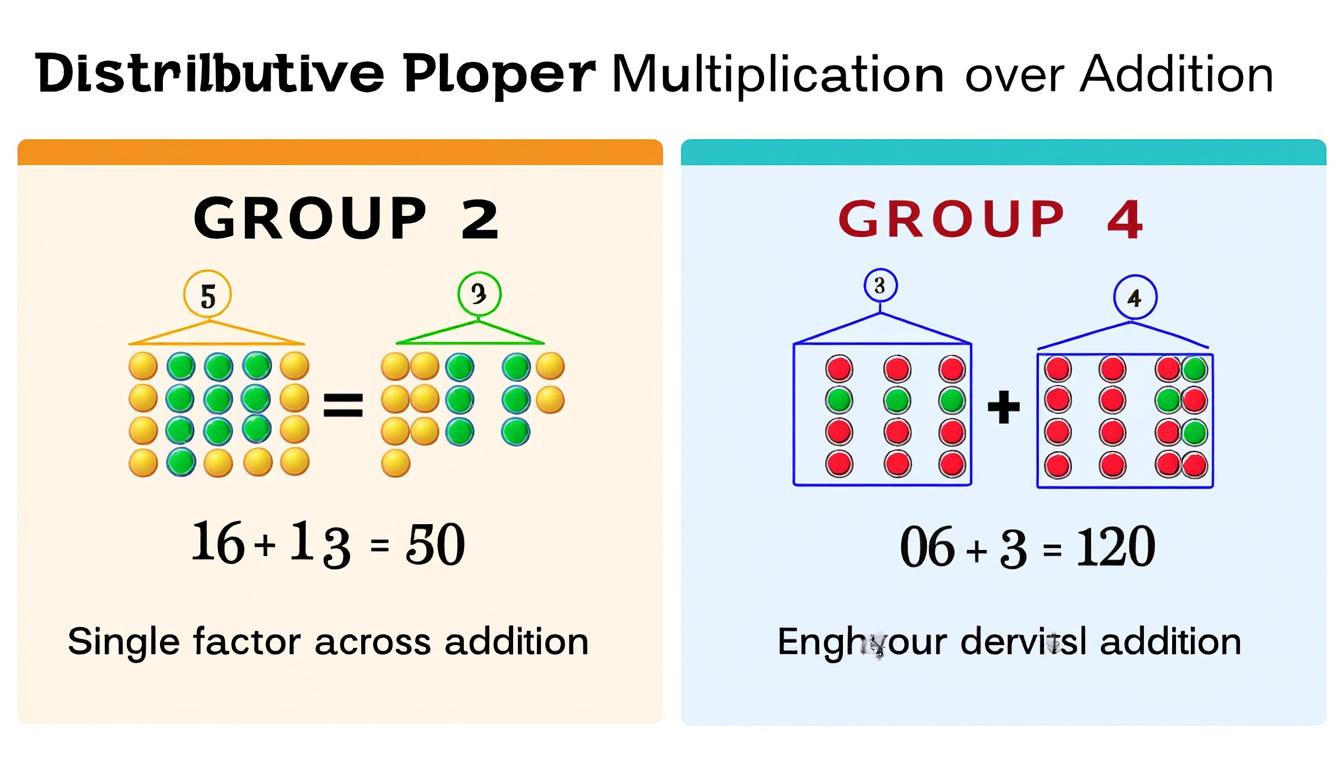
Practical Examples Illustrating the Distributive Property in Action
Understanding the abstract formula of the distributive property gains clarity when supplemented with concrete examples. These examples highlight its application in both arithmetic and algebra, demonstrating how complex expressions become approachable through distribution.
Multiplying a Sum by a Number
Consider the problem of calculating 6 × (20 + 5). Using the distributive property, you multiply 6 by each term inside the parentheses separately:
- Multiply 6 by 20: 6 × 20 = 120
- Multiply 6 by 5: 6 × 5 = 30
- Add the products: 120 + 30 = 150
This matches the result of directly multiplying 6 by 25, confirming the efficiency of the distributive approach for mental arithmetic and breaking down larger numbers into manageable parts.
Multiplying a Difference by a Number
Now, take 6 × (20 – 5). With subtraction inside the parentheses, the distributive property applies similarly:
- Multiply 6 by 20: 6 × 20 = 120
- Multiply 6 by 5: 6 × 5 = 30
- Subtract the second product from the first: 120 – 30 = 90
Again, this conforms to the straightforward solution of 6 × 15, emphasizing the property’s versatility in handling both addition and subtraction cases.
Distributive Property with Variables
When variables enter the equation, the distributive property remains applicable, aiding in expression simplification and polynomial expression manipulation. For example, to simplify −2(−x − 7), distribute −2 across each term:
- Multiply −2 by −x: (−2)(−x) = 2x (since a negative times a negative yields a positive)
- Multiply −2 by −7: (−2)(−7) = 14
- Add the results: 2x + 14
This simplification is fundamental in solving algebraic equations, emphasizing how the distributive property handles sign changes and variable terms effectively.
For a broader exploration of practical uses, check comprehensive illustrated examples at Complete Era’s examples.
Advanced Applications: Distributive Property in Algebraic Simplification and Factorization
Beyond basic arithmetic, the distributive property becomes an essential tool in manipulating algebraic expressions. In algebra, it is employed for expanding expressions, simplifying complex equations, and facilitating factorization. Mastery of this principle enables smoother manipulation of variables and constants within equations, leading to quicker solutions and a deeper understanding of equation structures.
Expanding Algebraic Expressions
Expanding expressions requires applying the distributive property to multiply a term across one or more terms inside parentheses. Take, for example, the expansion of 3(x + 4):
- Distribute 3 to both x and 4
- Calculate 3 × x = 3x and 3 × 4 = 12
- Write the expanded form as 3x + 12
Such expansion helps transition from a factored form to a simplified polynomial, which is often necessary in solving algebraic equations or analyzing function behavior.
Using Distributive Property for Factorization
On the flip side, the distributive property also underpins the process of factorization — rewriting expressions by extracting common factors. For instance, consider the expression 12x + 18: both terms share a common factor of 6. By factoring 6 out, the expression becomes:
12x + 18 = 6(2x + 3)
This inverse use of the distributive property enables simplification and is pivotal in solving equations by isolating terms or preparing equations for further operations.
Moreover, factoring is crucial in calculus, optimization problems, and real-world scenarios involving algebraic modeling. Developing a solid grasp of distributive property nuances thus fosters greater fluency in various mathematical domains.
Readers seeking to deepen their knowledge about algebraic properties, including distributive and identity properties, might find valuable insights from online resources such as this detailed guide on properties and identities.
Integration of the Distributive Property in Arithmetic and Division Strategies
While the distributive property most commonly relates to multiplication over addition and subtraction, a nuanced application in division also warrants attention. This is particularly helpful when breaking down division problems into easier steps through the “distribution” of the dividend.
For example, to solve 132 ÷ 6 efficiently, one can distribute 132 into partial dividends divisible by 6:
- Break 132 into 60 + 60 + 12
- Divide each partial dividend by 6: 60 ÷ 6 = 10, 60 ÷ 6 = 10, and 12 ÷ 6 = 2
- Add the quotients: 10 + 10 + 2 = 22
This method showcases how the distributive property can simplify division, making calculations more manageable without a calculator, which is especially useful in educational settings and mental arithmetic.
It is critical to note that successful application requires the partial dividends to be divisible precisely by the divisor; otherwise, the approach fails. For example, decomposing 132 into 50 + 50 + 32 would not be appropriate since neither 50 nor 32 is divisible by 6 without remainder.
Understanding these subtleties enriches problem-solving abilities and strengthens arithmetic fluency.
| Operation Type | Expression Example | Distributive Property Application | Result |
|---|---|---|---|
| Multiplication over Addition | 6 × (20 + 5) | 6 × 20 + 6 × 5 | 120 + 30 = 150 |
| Multiplication over Subtraction | 6 × (20 − 5) | 6 × 20 − 6 × 5 | 120 − 30 = 90 |
| Division via Distribution | 132 ÷ 6 | (60 + 60 + 12) ÷ 6 = 60 ÷ 6 + 60 ÷ 6 + 12 ÷ 6 | 10 + 10 + 2 = 22 |
| Algebraic Expansion | 5(x + 2) | 5 × x + 5 × 2 | 5x + 10 |
| Factorization | 12x + 18 | 6(2x + 3) | Factored form |
Common Challenges and Strategic Benefits of Applying the Distributive Property
Although straightforward in theory, the distributive property can sometimes present challenges, especially for learners encountering variables and negative signs. However, once mastered, it empowers users with mathematical flexibility and deeper insight into equation structure.
Addressing Common Pitfalls:
- Misapplication with Negative Signs: Students often overlook the change in sign when distributing a negative multiplier, which can lead to erroneous results. Careful attention is essential when handling expressions like −2(−x − 7).
- Overlooking Distribution Across All Terms: Failing to multiply the outside term by every individual term inside the parentheses diminishes the property’s effectiveness.
- Dividing Incorrectly with Division: Misusing distribution in division by breaking down divisors instead of dividends leads to incorrect answers, underscoring the importance of understanding where distribution applies.
Mastering these aspects encourages confidence in tackling a variety of algebraic and arithmetic problems. Notably, the distributive property enhances mental math skills by allowing complex multiplications and divisions to be broken down into simpler, more manageable parts.
As a summary of strategic benefits, here are five advantages of applying the distributive property in mathematics:
- Simplifies complex calculations by breaking them into smaller parts.
- Enables expansion and factorization of algebraic expressions.
- Improves mental math abilities through flexible computation techniques.
- Supports deeper understanding of algebraic structures.
- Facilitates error checking by providing an alternative approach to solving expressions.
For further tips on handling mathematical properties efficiently and enhancing problem-solving skills, readers may refer to this resource on mathematical identities, which complements understanding of the distributive property.