
In the intricate landscape of algebra, the identity property stands out as a fundamental principle that underpins the manipulation and simplification of equations. This property uniquely highlights certain elements—specifically zero and one—that do not alter the value of other numbers when applied through addition or multiplication. Its relevance spans from the basics of arithmetic operations to complex algebraic expressions involving variables and inverses. Understanding how the identity property operates not only streamlines problem-solving but also enriches the learner’s grasp of mathematical structure and logic, crucial for advancing in algebraic studies and beyond.
Key points on the identity property in algebra:
- Additive identity is zero (0), which leaves any number unchanged when added.
- Multiplicative identity is one (1), maintaining any number’s value when multiplied.
- These identities simplify the handling of variables and complex equations.
- Recognizing identity elements prevents common mistakes in algebraic manipulation.
- The identity property serves as a foundational concept linking arithmetic to advanced mathematics concepts like inverses and zero properties.
The Foundations of Identity Property: Additive and Multiplicative Identities in Algebra
The identity property forms the backbone for understanding how numbers interact through various operations without altering their inherent value. In algebra, two primary identity properties are pivotal: the additive identity and the multiplicative identity.
The Additive Identity Explained
The additive identity centers on the number zero (0). By definition, zero is the unique number that can be added to any other number without changing its value. Algebraically, this is represented as a + 0 = a. This rule holds true regardless of whether the number is a constant or a variable. The significance of the additive identity surfaces when simplifying expressions and solving equations, as it allows for the elimination of redundant terms.
To illustrate, consider the expression 5 + 0; the result is simply 5, because adding zero does not affect the number. Similarly, if x is a variable, then x + 0 = x applies universally, ensuring the ease of simplifying algebraic expressions involving variables.
In practical applications, the additive identity helps when dealing with real-world problems. For example, if you have 15 dollars and receive zero additional dollars, your total remains 15—a direct reflection of this property.
Understanding the additive identity also assists students in avoiding unnecessary complexity. When students first encounter equations like (x + 0) + 5, recognizing that x + 0 simplifies to x streamlines their problem-solving pathway.
The Multiplicative Identity Explained
Parallel to the additive identity is the multiplicative identity, which designates the number one (1) as the neutral element in multiplication. In algebra, this is expressed as a × 1 = a. This tells us that multiplying any number by one leaves its value intact. This principle is fundamental in both elementary arithmetic and in the simplification of algebraic expressions, especially those involving variables and coefficients.
For instance, the multiplication operation 7 × 1 results in 7, and when variables come into play, x × 1 = x. This intrinsic property is essential when solving equations, as it permits simplification by discarding multiplicative factors of one without altering the value of the expression.
Consider a real-life scenario: If you purchase 10 items and multiply the quantity by 1, you still have 10 items, signifying no change. This example embodies how the multiplicative identity functions beyond abstract numbers and into concrete situations.
When economizing algebraic expressions such as (x × 1) × 8, acknowledging the multiplicative identity reduces the expression neatly to 8x, demonstrating the power of this property in algebraic manipulation.
A practical grasp of these identities is vital for students progressing to advanced mathematics, as it lays the groundwork for understanding inverses and other algebraic properties linked in properties of identity, inverses, and zero essential in algebraic theory and application.

Common Pitfalls When Working with the Identity Property in Algebraic Equations
Despite the apparent simplicity of the identity property, students frequently encounter stumbling blocks in its application. Recognizing and understanding these common errors is paramount to mastering algebraic problem-solving and avoiding missteps that can derail an otherwise straightforward calculation.
Confusing Zero and One
One of the most pervasive errors involves misidentifying the roles of zero and one within arithmetic operations. A common mistake is to interchange their positions—using zero in multiplication as if it were the multiplicative identity or one in addition as if it were the additive identity. Such confusion leads to flawed simplifications.
For example, assuming that multiplying by zero leaves a number unchanged contradicts the zero property of multiplication, which results in zero regardless. Conversely, adding one and expecting the value to remain constant misrepresents the additive identity’s function.
Misapplying Identities in Complex Expressions
Another frequent problem arises when students apply identity properties incorrectly within larger expressions or equations. For instance, they might attempt to « cancel out » terms assuming they behave like identity elements without verifying that those terms actually are identities. This can result in loss of information or incorrect final answers.
A typical scenario might involve overlooking the fact that subtracting zero preserves the original number, i.e., a – 0 = a, whereas subtracting other numbers alters it. Similarly, recognizing that only one can serve as a multiplicative identity prevents erroneous division or cancellation in fractions or products.
Neglecting the Identity Property’s Simplification Power
At times, the identity property is underutilized because students fail to spot opportunities to simplify equations using it. For example, oversights such as not reducing expressions like x + 0 or x × 1 delay problem resolution and increase cognitive load unnecessarily.
Another overlooked detail is the importance of the identity property for preserving the structure of equations during transformations. This underlies objectivity in algebraic reasoning and aids in tracing back through steps to verify solutions.
Strategies to Avoid Mistakes
- Distinguish identity elements: commit to memory that zero pertains to addition and one to multiplication.
- Double-check equation structures: ensure that identity properties are correctly applied only where valid.
- Practice with diverse problems: exposure to varied equations improves intuitive recognition of the identities.
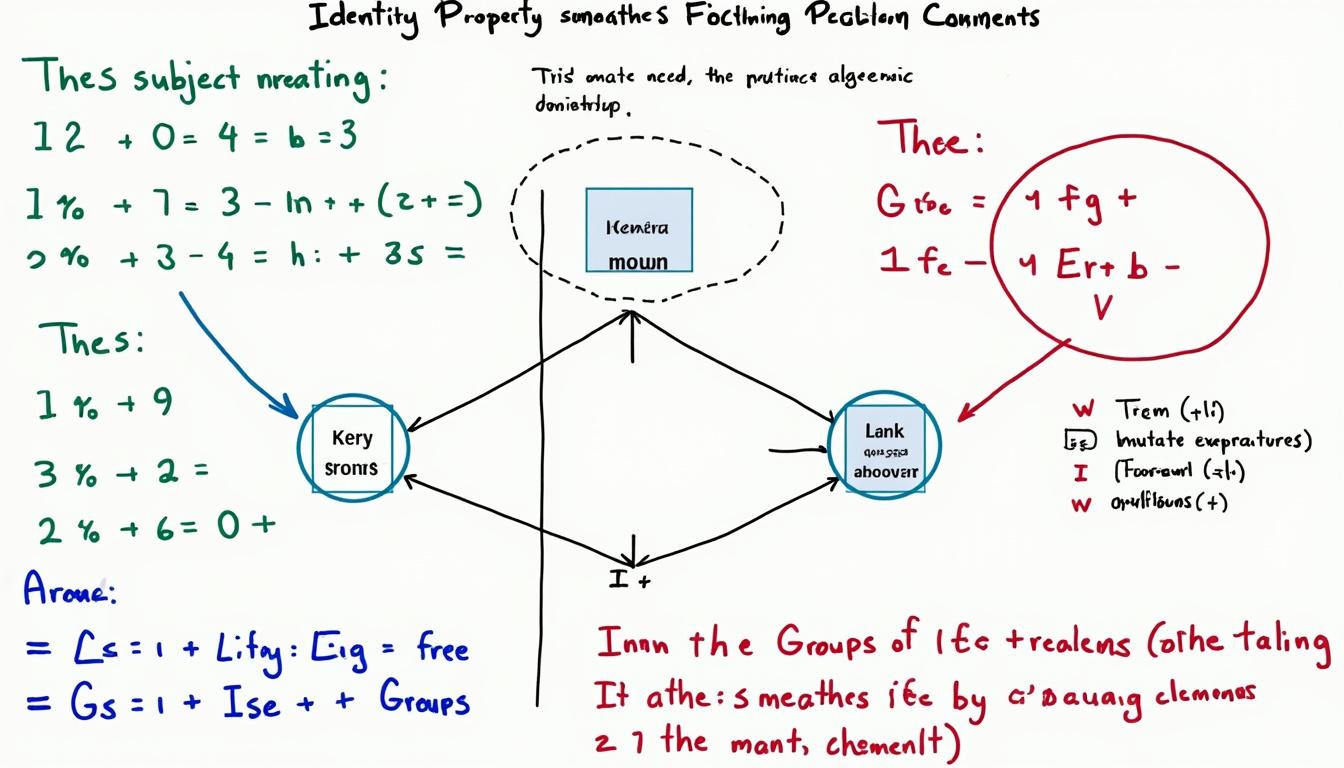
- Use visual aids: diagrams or flowcharts can illustrate the relevance of identities in transformations.
These approaches provide a robust framework to master the identity property and enhance algebraic fluency.
Applying Identity Properties in Advanced Algebra: Variables, Inverses, and Equation Solving
The utility of identity properties extends well beyond basic arithmetic into the realm of variables and the solving of complex algebraic equations. Here, identity properties become indispensable tools for simplifying expressions and working with inverses—concepts fundamental to understanding algebraic structures and functions.
Manipulating Variables with Identity Elements
Variables provide an abstract representation of numbers, requiring a firm grasp of properties like the additive and multiplicative identities to manipulate expressions correctly. For example, when simplifying (x + 0) + y, understanding that x + 0 = x allows the expression to reduce naturally to x + y.
Similarly, in multiplication, x × 1 = x facilitates simplifications and the execution of distributive tasks without altering the value of variable expressions, essential in algebraic factoring or expansion.
Inverses and Their Relationship to Identity Properties
In algebra, inverse elements are intimately linked to identity properties. The additive inverse of a number (a) is a number that, when added to (a), produces the additive identity zero. For example, the inverse of 7 is -7 because 7 + (-7) = 0. Similarly, the multiplicative inverse of a nonzero number (a) is its reciprocal (1/a), which yields the multiplicative identity one when multiplied by (a).
The understanding of these inverses depends on a solid grasp of the identity property since they are defined relative to the identity elements. Mastering this relationship aids students in solving equations involving variables, such as linear equations and rational expressions.
Identity Property in Equation Solving
When solving equations, identity properties serve as anchors. For example, in equations like x + 0 = 12 or x × 1 = 9, identifying the presence of identity elements immediately simplifies to x = 12 and x = 9, respectively, bypassing unnecessary operations.
In practical problem solving, recognizing and applying these identities accelerates solutions and avoids common pitfalls, especially when dealing with complex algebraic expressions or systems.
| Algebraic Operation | Identity Element | Example Expression | Result |
|---|---|---|---|
| Addition | 0 (Additive Identity) | x + 0 | x |
| Multiplication | 1 (Multiplicative Identity) | x × 1 | x |
| Additive Inverse | Number that sums to 0 | x + (-x) | 0 |
| Multiplicative Inverse | Number that multiplies to 1 | x × (1/x) | 1 |
The Role of the Identity Property in Simplifying Algebraic Expressions and Its Impact on Mathematical Logic
Simplification lies at the heart of algebraic problem-solving, and the identity property plays an essential role in streamlining this process while supporting the logic underpinning mathematical reasoning. It ensures that the underlying value of quantities remains consistent throughout transformations, a necessity for precise and correct solutions.
Simplifying Expressions through Identity Elements
One of the profound uses of the additive and multiplicative identities is their ability to simplify complex expressions. For instance, consider the expression:
(3y + 0) × (1 + 4). Applying the additive identity, we immediately replace 3y + 0 with 3y. The expression becomes 3y × 5, which further simplifies to 15y. This eliminates redundant parts, reducing cognitive load and streamlining calculations.
In similar fashion, in expressions involving variables, leveraging identity properties can clarify terms and reduce the number of operations required to reach a solution. This is especially crucial in algebra courses and standardized tests where efficiency is important.
Impact on Understanding Mathematical Logic and Structure
The identity property transcends mere computational convenience. It embodies the idea of a neutral element in algebraic structures such as groups and rings, which feature prominently in higher mathematics. This neutrality, where an element does not alter another when combined, forms the basis of many algebraic rules and theorems.
By consistently applying identity properties, students and practitioners enhance their intuition about the behavior of numbers within algebra. This understanding undergirds the development of critical thinking skills applicable across STEM fields requiring logical precision.
For further in-depth study on algebraic properties, the resources at CK-12 Foundation’s Algebraic Properties offer comprehensive explanations and examples that complement this overview.
Techniques and Tips for Mastering the Identity Property in Algebra for Effective Learning
Achieving fluency in the identity property demands a strategic approach combining practice, memorization, and conceptual clarity. Employing deliberate learning techniques ensures that students can recognize and use these properties skillfully in varied contexts.
Effective Memorization and Concept Reinforcement
Flashcards serve as an excellent tool for committing both the additive and multiplicative identities to memory. By repeatedly practicing the statements “adding zero does not change a number” and “multiplying by one leaves a number unchanged,” learners reinforce the core tenets in accessible formats.
Mnemonics can help differentiate between the two identities. For example, the phrase “Zero for addition, One for multiplication” succinctly encapsulates the essence of the identity property and aids recall under pressure.
Regular Practice with Varied Problem Types
Incorporating daily drills on diverse algebraic expressions that utilize identity properties deepens retention and builds confidence. These exercises should span simple additions and multiplications to complex expressions involving variables and inverses.
Dynamic online platforms such as Mathnasium’s Identity Property tutorials provide interactive practice opportunities that adapt to individual learning speeds and needs, making mastery more attainable.
Engaging Collaborative and Visual Learning
Studying in groups encourages the exchange of perspectives, with peer explanations clarifying subtle nuances and reinforcing understanding. Visual tools like flowcharts or algebra trees can illustrate where and how identity elements influence expressions, reinforcing conceptual connections.
Self-Assessment and Reflective Review
Periodic quizzes and self-assessment exercises help detect misunderstandings and gaps. Reflecting on errors ensures misconceptions are addressed, paving the way for progressive improvement and mathematical precision.
- Build flashcards for additive and multiplicative identities.
- Use mnemonic devices for easy recall during tests.
- Engage regularly with practical algebra problems involving variables.
- Leverage online interactive tutorials and exercises.
- Practice collaborative problem-solving and peer teaching.