
The Addition Property of Equality is a fundamental concept in mathematics, particularly in algebra, that ensures the balance of an equation is maintained when the same value is added to both sides. This principle underpins the process of solving equations, enabling us to isolate variables and unlock unknowns in mathematical expressions. Whether dealing with simple whole numbers, fractions, or variables, understanding how this property operates provides the foundation for advanced mathematical reasoning and problem-solving.
In the evolving educational landscape of 2026, where emphasis on critical thinking and applied knowledge strengthens, grasping the Addition Property of Equality is essential. This property not only bridges basic arithmetic with higher algebraic methods but also plays a pivotal role in practical real-world applications—ranging from engineering calculations to data analysis and even computer science algorithms.
Mastering this property means mastering the art of keeping equations balanced, much like a perfectly leveled scale, regardless of the complexity of the numbers involved. Such understanding empowers students, educators, and professionals to approach mathematical challenges with confidence and clarity.
In brief:
- Maintains equality: Adding the same quantity to both sides keeps an equation balanced.
- Solves for variables: Essential in isolating variables to find unknown values in equations.
- Universal applicability: Works with integers, fractions, decimals, and negative numbers.
- Basis for advanced math: Foundation for subtraction, multiplication, division properties of equality.
- Visualized as balance: The equation is like a scale that stays balanced when equal amounts are added.
Core Principles of the Addition Property of Equality in Algebra
The Addition Property of Equality asserts a simple yet powerful rule: if two expressions are equal, then adding the same value to both does not disrupt that equality. Mathematically, if a = b, then a + c = b + c, for any real numbers a, b, and c. This foundational axiom ensures that the balance of an equation is preserved, and it plays a crucial role in solving algebraic equations.
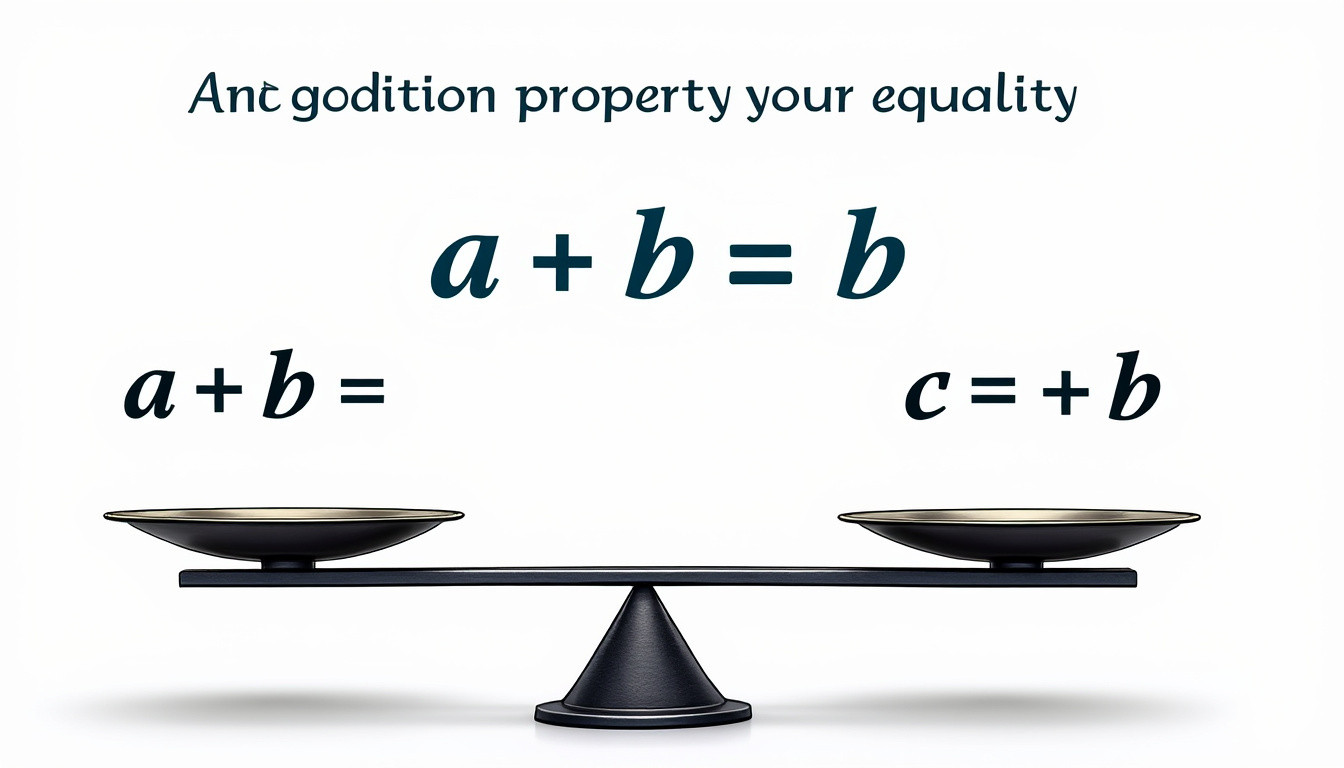
Imagine an equation as a weighing scale, perfectly balanced, with the left side representing one expression and the right side another. If you add weight to only one side, the scale tips and balance is lost. The Addition Property of Equality dictates that to keep balance, any addition to one side must be equally duplicated on the other side.
For example, consider the equation 5 = 5. If we add 3 to the left side only, it becomes 8 ≠ 5, which destroys equality. However, adding 3 to both sides gives 8 = 8, maintaining equality perfectly.
This property extends beyond simple numbers. It applies to variables and expressions, such as solving x – 4 = 10. By adding 4 to both sides—thanks to this property—we isolate the variable: x – 4 + 4 = 10 + 4, which simplifies to x = 14. Such operations highlight how the Addition Property of Equality is instrumental in algebraic manipulations.
To explore further concepts and examples, authoritative resources such as Cuemath’s guide on the Addition Property of Equality provide extensive explanations that illuminate its fundamental role in mathematics.
The Role of the Addition Property of Equality in Solving Equations
Understanding the Addition Property of Equality is essential for solving various types of equations—linear, fractional, and even those involving negative numbers. It serves as the groundwork to isolate the variable and simplify expressions logically and systematically.
Consider the linear equation 2x – 3 = 7. The goal is to find the value of x. Applying the Addition Property of Equality, add 3 to both sides to cancel out the −3:
- 2x – 3 + 3 = 7 + 3
- Simplify: 2x = 10
- Next steps involve division, but the addition property has created a balanced, simplified equation to work with.
Beyond integers, this rule also governs fractional equations. Take the example z – 1/2 = 3/2. Adding 1/2 to both sides balances the equation:
- z – 1/2 + 1/2 = 3/2 + 1/2
- z = 2
This demonstrates the consistent applicability of the property regardless of numeric format. It ensures that the equality remains valid, providing a reliable mechanism for manipulating equations.
In real-world contexts, such as financial calculations or physics, maintaining balanced operations is critical. For instance, when determining unknown variables in budgeting equations or balancing chemical reactions, the Addition Property ensures findings are mathematically sound.
The practical significance of this property is detailed in educational content, highlighting strategies for examples and applications of the Addition Property of Equality that aid learners and professionals alike.
Applying the Addition Property of Equality with Variables and Complex Expressions
The scope of the Addition Property of Equality extends far beyond basic arithmetic. In more advanced algebraic scenarios, it applies seamlessly to expressions involving multiple variables, combined terms, and complex equations. It remains a pivotal tool in isolating variables and simplifying equations, regardless of complexity.
For instance, consider this multi-step equation:
3x + 5 – x = 7
First, combine like terms on the left-hand side:
2x + 5 = 7
Next, apply the addition property by adding −5 to both sides to isolate the variable term:
2x + 5 – 5 = 7 – 5
Simplify:
2x = 2
Finally, dividing both sides by 2 solves for x:
x = 1
Such stepwise usage of the Addition Property demonstrates how the principle provides discipline and structure to solving equations, preserving equality at each stage. It also assists in handling expressions with negative values or fractions embedded within variables.
The property supports the logic behind algebraic transformations, ensuring that all operations maintain the true value of the equation. This is why it often appears paired with the Subtraction Property of Equality and multiplication properties when solving complex problems.
Its versatility is evident when dealing with equations containing variables on both sides. For example:
2x + 3 = x + 7
Applying the addition property, subtract x from both sides:
2x – x + 3 = 7
Then subtract 3 from both sides (again, utilizing the addition property in its inverse form):
x = 4
This cohesive flow illustrates how addition and other properties of equality integrate to support algebraic problem-solving.

Common Misapplications and Errors in Using the Addition Property of Equality
Despite the apparent simplicity of the Addition Property of Equality, certain misconceptions and errors frequently arise, particularly among students and early learners. Recognizing these mistakes is critical to reinforce proper understanding and application of the property.
1. Adding to only one side: The most frequent error occurs when a student adds a value solely to one side of the equation, breaking the balance and invalidating the equality. For example, misapplying the property to solve x + 2 = 5 by adding 2 only to the left side transforms the equation incorrectly.
2. Adding the wrong value: Sometimes the added number is not the correct counterpart needed to isolate variables. For example, if the equation is x – 6 = 10, adding 10 (instead of 6) to both sides does not eliminate the constant properly.
3. Ignoring signs and negatives: Even subtle omissions like forgetting that subtracting a negative number equates to addition can cause errors. For example, solving x – (-2) = 5 requires understanding that subtracting a negative is the same as adding a positive.
4. Forgetting to simplify: After applying addition to both sides, forgetting to combine like terms or simplify the equation can leave students stuck or confused in subsequent steps.
To avoid these pitfalls, consistent practice and guided instruction are essential. Visual aids like balance scales and algebra tiles help reinforce the idea that both sides must be treated symmetrically. Educational materials with curated exercises and feedback, much like those available at Mathwords, can reinforce accurate usage.
Understanding these common errors sharpens one’s algebraic reasoning and builds a more intuitive grasp of equation balancing.
Practical Examples, Exercises, and Insights on the Addition Property of Equality
Fully grasping the Addition Property of Equality comes alive through real examples and sustained practice. Let’s explore some typical use cases, exercises, and problem-solving strategies to solidify comprehension.
- Example 1: Solve for k in the equation k – 5 = 15.
- Apply addition property: add 5 to both sides.
- k – 5 + 5 = 15 + 5
- Simplify to get k = 20.
- Example 2: Balancing marbles in hands.
- Martha has 7 marbles in each hand (7 = 7).
- Her friend gives her 6 more marbles, which can be split evenly, so she adds 3 to each hand.
- Thus, 7 + 3 = 7 + 3 or 10 = 10.
- Example 3: Showing x + y = 7 given y = z and z = 7 – x.
- Add x to both sides of the second equation: z + x = 7.
- Since y = z, replace to get y + x = 7.
Practicing such examples enhances fluency with this property and translates into faster, more confident equation-solving skills.
| Equation | Operation | Result |
|---|---|---|
| x – 7 = 12 | Add 7 to both sides | x = 19 |
| y – 3 = 8 | Add 3 to both sides | y = 11 |
| z – 1/2 = 3/2 | Add 1/2 to both sides | z = 2 |
| 2x – 3 = 6 | Add 3 to both sides, then divide by 2 | x = 9/2 |
More complex equations can be tackled by combining the Addition Property with other properties of equality. For comprehensive problem sets and guided solutions, resources like AllMath’s detailed explanations provide valuable learning pathways.