
Wright County’s property tax system stands as a crucial pillar supporting local government functions and community services, shaping the financial landscape for homeowners across central Minnesota. As property taxes contribute significantly to funding schools, roads, emergency services, and overall county operations, understanding how these taxes are calculated and how they impact homeowners’ monthly costs is indispensable for anyone owning real estate in the region.
In Wright County, property tax rates fluctuate depending on the exact location of a property, reflecting the diverse mix of cities, townships, school districts, and special taxing districts within its borders. Homeowners face rates ranging from just under 1% to beyond 1.5%, with the county-wide median rate hovering around 1.2%. These nuances are vital to grasp, especially since the assessed value — which determines the tax base — often differs substantially from a property’s market value.
For homeowners navigating these intricacies, awareness of applicable tax exemptions, deadlines for payments, and the processes for appealing assessments can translate into meaningful financial benefits. Keeping abreast of these factors not only helps manage homeownership costs but also equips residents with the tools to advocate for fair assessments within Wright County’s tax framework.
Key Takeaways
- Wright County’s property tax rate varies by location, generally between 1.0% and 1.5%, influencing each homeowner’s property tax bill differently.
- The property tax assessment is based on an assessed value determined annually, which may differ from the market value and can be appealed.
- Homeowners benefit from tax exemptions such as the homestead credit, senior, and disabled veteran exemptions, which require annual applications.
- Property taxes are typically paid in two installments: due dates in May and October, with penalties for late payments affecting financial planning.
- Mortgage borrowers often utilize escrow accounts managed by lenders to streamline property tax payments and avoid penalties.
How Wright County Calculates Property Tax: A Detailed Breakdown
The foundation of Wright County’s property tax system lies in its method of determining taxable value, a figure that hinges on both the assessed market value of property and statutory classification rates. Each year, the Wright County Assessor’s Office reviews property valuations as of January 2 and calculates assessments based on recent sales, property condition, and comparable properties, ensuring that the taxation remains equitable and reflective of current market dynamics.
Unlike what many might assume, the assessed value used for tax calculations typically does not match the property’s latest sales price. Instead, the assessor applies a classification rate—commonly 90% for homestead residential properties—which adjusts the market value to arrive at the taxable value. This approach helps maintain consistency across the county and prevents sudden spikes in tax liabilities.
For instance, if a home in Wright County is assessed at $350,000, the taxable value after the 90% classification might be $315,000. The property’s tax bill then depends on the total local tax rate, which encompasses levies from school districts, county government, cities, and special authorities.
It is crucial for homeowners to recognize that local taxing authorities can levy varying rates, leading to significant differences in the overall tax rate between neighborhoods. For example, residents within different school districts or cities may see their combined tax rates fluctuate from just under 1% to as high as 1.5% or above. Such variability directly influences the property tax bills homeowners receive, often becoming a decisive factor in real estate decisions.
Because assessments are recalculated annually, homeowners should pay close attention to the assessment notices mailed each spring. These notices detail the property’s assessed and taxable values and serve as the basis for the tax levy calculation. Should a homeowner disagree with the assessed value, they have the right to file an appeal during the designated period, typically before April 30th for Wright County.
Understanding the calculation process helps homeowners prepare for potential changes in their tax obligations and explore avenues for adjustment if the assessment seems disproportionate. For more details on specific rates and property tax calculations, the Wright County Assessor’s website offers a comprehensive property tax search tool allowing residents to examine parcel-specific assess valuations and tax rates in depth.
Components of Your Wright County Property Tax Bill
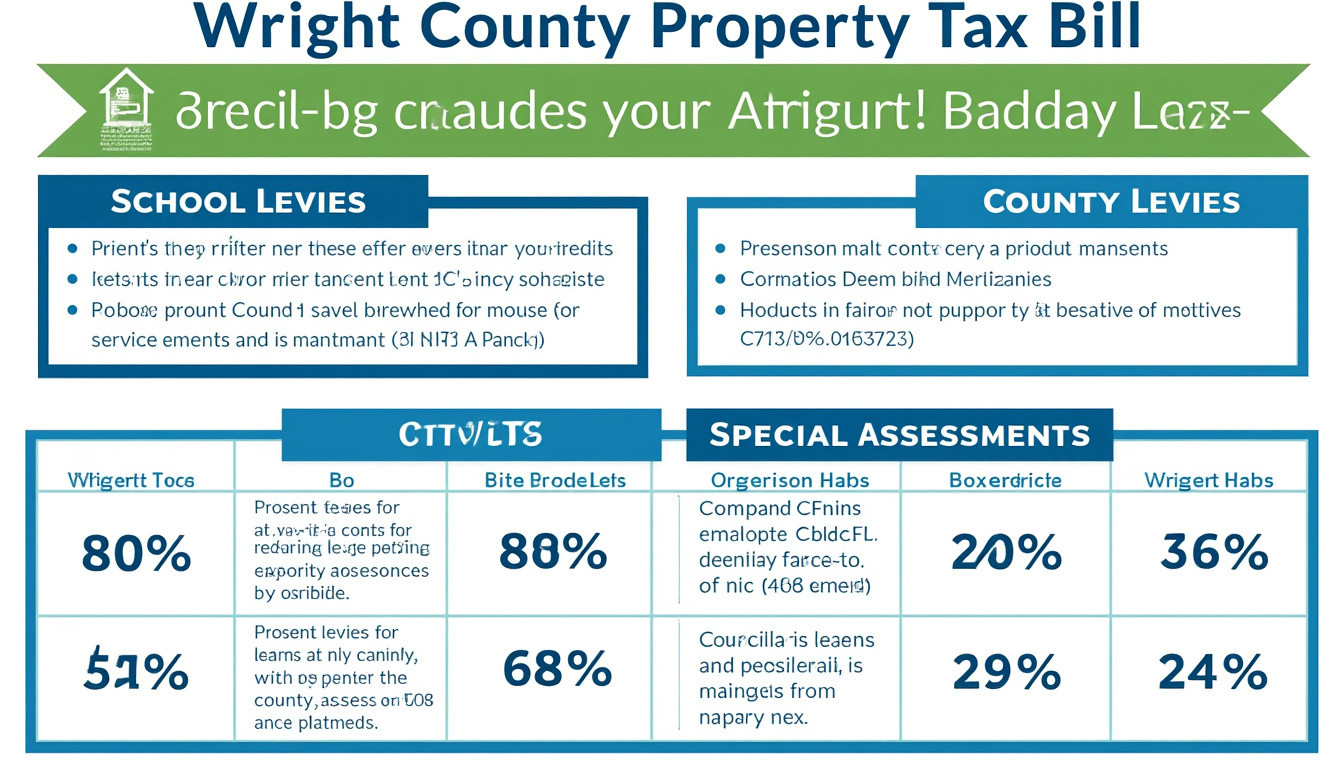
The property tax bill in Wright County is a composite of multiple levies that fund diverse aspects of local government and public services. Breaking down the bill provides homeowners with transparency regarding where their payments are directed and helps them grasp the local priorities supported by property tax revenue.
The principal components generally include:
- School District Levies: Constituting roughly 50-60% of the total property tax bill, funds from this levy support public education infrastructure and operational costs.
- County Services: Approximately 15-20% of a homeowner’s tax bill goes to county-level services such as law enforcement, road maintenance, judicial facilities, and administrative functions.
- City or Township Services: These represent around 20-30% of the tax bill, financing parks, emergency services, local road upkeep, police, and fire protection.
- Special Assessments and Districts: These vary by property location and can include watershed management, library services, fire protection districts, and bonded debt assessments used for capital improvements.
Each of these segments reflects specific budgetary requirements and the community’s infrastructure and service demands. Due to the diverse needs across Wright County’s cities and townships, property tax rates and their composition will differ notably, making it essential for homeowners to review their individual statements carefully.
| Tax Component | Percentage of Total Bill | Example Tax Rate Per $100 Assessed Value |
|---|---|---|
| School District Levy | 50-60% | $0.60 |
| County Services | 15-20% | $0.20 |
| City/Township Services | 20-30% | $0.25 |
| Special Assessments | Varies | $0.05 – $0.10 |
Understanding the breakdown empowers taxpayers to grasp how their contributions sustain vital community functions. To view personalized breakdowns or to access your current property tax bill, consult Wright County’s official property tax portal or the detailed tax guides available at authorized sites.
Critical Deadlines and Payment Strategies for Wright County Homeowners
Effective management of property tax payments is an integral part of homeownership in Wright County. To avoid penalties and maintain good standing, homeowners must be aware of key due dates and adopt payment strategies that align with their financial planning.
Property taxes in Wright County for the 2025/2026 tax year are divided into two installments:
- First Installment: Due by May 15, with penalties beginning after December 10.
- Second Installment: Due by October 15, with penalties after April 10 the following year.
These deadlines are strictly enforced, with late payments incurring penalties—3% for the first month and 1% for each following month—along with interest charges. Over time, unpaid taxes could lead to property tax forfeiture, underscoring the importance of timely payment.
Homeowners with mortgages typically encounter property tax escrow accounts managed by their lenders. These accounts collect a portion of estimated annual taxes monthly along with mortgage payments, ensuring the lender disburses tax payments on behalf of the homeowner accurately and promptly. This arrangement can significantly ease payment burdens by spreading tax expenses throughout the year instead of facing lump sum demands.
However, if a homeowner pays property taxes directly, it is prudent to set calendar reminders and budget accordingly to meet both installment deadlines. Monitoring your escrow account information annually, including payment analysis statements from lenders, helps verify that funds are appropriately allocated and avoid unexpected shortages.
For direct payments or to verify tax status, the Wright County Treasurer’s Office provides multiple payment methods, including an online portal designed to streamline the process. More detailed information and payment instructions can be found on the official Wright County property tax website.
Adapting your payment method to your financial situation, such as establishing escrow or scheduling direct payments, is crucial for effective tax management in Wright County.
Essential Tax Exemptions and Appeals That Can Lower Your Wright County Property Tax Bill
Recognizing and applying for applicable tax exemptions provides an effective means for Wright County homeowners to reduce their property tax burden. The most prominent exemption is the homestead credit, which applies to primary residences and caps annual assessment increases, thus providing tax relief without reducing market value.
To maintain eligibility for the homestead exemption, homeowners must file an annual application and demonstrate occupancy of the property as their principal residence as of January 2 in the tax year. The Wright County Assessor’s office manages these applications and offers guidance on eligibility and submission deadlines.
Additional exemptions exist for seniors, disabled veterans, and agricultural landowners. For example, seniors and disabled homeowners with incomes below certain thresholds may qualify for deferrals or partial exemptions, easing their tax burden during retirement or disability. Agricultural properties receive preferential classification rates, typically as low as 10%, compared to residential homestead rates.
Notably, these exemptions are not applied automatically; homeowners must be proactive in filing annual applications to benefit fully.
If you believe your property’s assessed value inaccurately reflects its market worth, you have the right to appeal the assessment. The appeal process begins with filing a written objection to the County Board of Review by the end of April or early May each year. It is advisable to support your appeal with evidence such as recent sales of comparable properties, professional appraisals, or documentation of property defects.
Appealing assessments is a common and often successful strategy, with many homeowners managing to reduce their assessed values by 5-15%, resulting in significant tax savings. If dissatisfied with the outcome at the county level, further appeals can be made through the Minnesota Department of Revenue or the state’s Tax Court.
Keeping good records, staying informed of deadlines, and utilizing the appeals and exemption systems available can make a substantial difference in managing your homeownership costs.
For those looking to delve deeper into tax relief programs and appeal processes, resources like HonestCasa’s Wright property tax guide and the Wright County Assessor’s official site provide robust tools and detailed instructions.
Managing Wright County Property Taxes as Part of Your Homeownership Costs
Property taxes form one segment of the overall expense of homeownership, combining with mortgage payments, insurance, and homeowners association fees to shape monthly financial responsibilities. In Wright County, these taxes often present one of the largest variable costs due to changing assessments and fluctuating tax rates.
Homeowners frequently use mortgage escrow accounts to consolidate tax and insurance payments into monthly installments, facilitating budgeting and protecting against missing crucial payment deadlines. However, escrow adjustments can lead to elevated monthly payments if property taxes rise following reassessments or tax rate increases by local government.
Therefore, homeowners should regularly review their escrow statements annually, verifying the accuracy of projected tax amounts and planning for possible increases. If you find your escrow payments rising unexpectedly, investigating the underlying causes, such as recent property valuation hikes or changes in local government levies, is essential.
Understanding the broader financial impact of property taxes also helps when considering home equity loans or refinancing options. Licensed loan officers experienced with Wright County property tax nuances can assist homeowners in evaluating how taxes affect monthly payments and overall affordability.
- Review your annual property tax bill and assessment notices carefully
- Ensure you’re properly enrolled in all eligible tax exemptions
- Maintain accurate records to support assessment appeals if necessary
- Consult with financial advisors or loan officers about the implications of increased property tax on mortgage and escrow payments
- Stay updated with Wright County tax deadlines to avoid penalties and interest
Balancing property tax obligations alongside mortgages and insurance contributes to a comprehensive understanding of homeownership costs. Information available through official channels such as the Wright County property tax information portal provides essential tools for taxpayers to manage these components effectively.