
The distributive property stands as a fundamental pillar in algebra and arithmetic, intricately weaving together multiplication and addition to simplify calculations that might otherwise seem complex. This property not only facilitates the transformation of multifaceted expressions into manageable parts but also deepens the learner’s comprehension of how different math principles interact. Amidst the landscape of algebraic operations, understanding how multiplication distributes over addition or subtraction reveals patterns and strategies that streamline problem-solving.
In today’s mathematical practices, the distributive property enables both students and professionals to unpack expressions efficiently, preserving the integrity of equations while enhancing computational ease. Whether unraveling the sum inside parentheses or expanding expressions with variables, this property is indispensable for simplifying and factorizing expressions, ultimately converting challenging problems into solutions that anyone can tackle. Tracing the roots of algebra, the distributive property remains a vital concept fostering clarity and fluency in mathematical reasoning.
At the intersection of multiplication and addition lies a method that carries not only theoretical importance but also practical applications, ranging from basic arithmetic to advanced algebraic problem solving. Embracing this principle unlocks a deeper engagement with equations and expressions, making it easier to decode, manipulate, and solve diverse mathematical challenges with confidence.
Key Insights:
- The distributive property links multiplication with addition and subtraction to simplify algebraic expressions.
- Rearranging factors and terms optimizes calculations by breaking down complex problems into smaller parts.
- Understanding this property is crucial for mastering algebra, factorization, and solving equations.
- Applying distributive techniques enhances skills like simplification and recognizing patterns across diverse math problems.
- Mastery of distributive concepts prepares learners to tackle real-world math applications efficiently.
How the Distributive Property Bridges Multiplication and Addition in Algebra
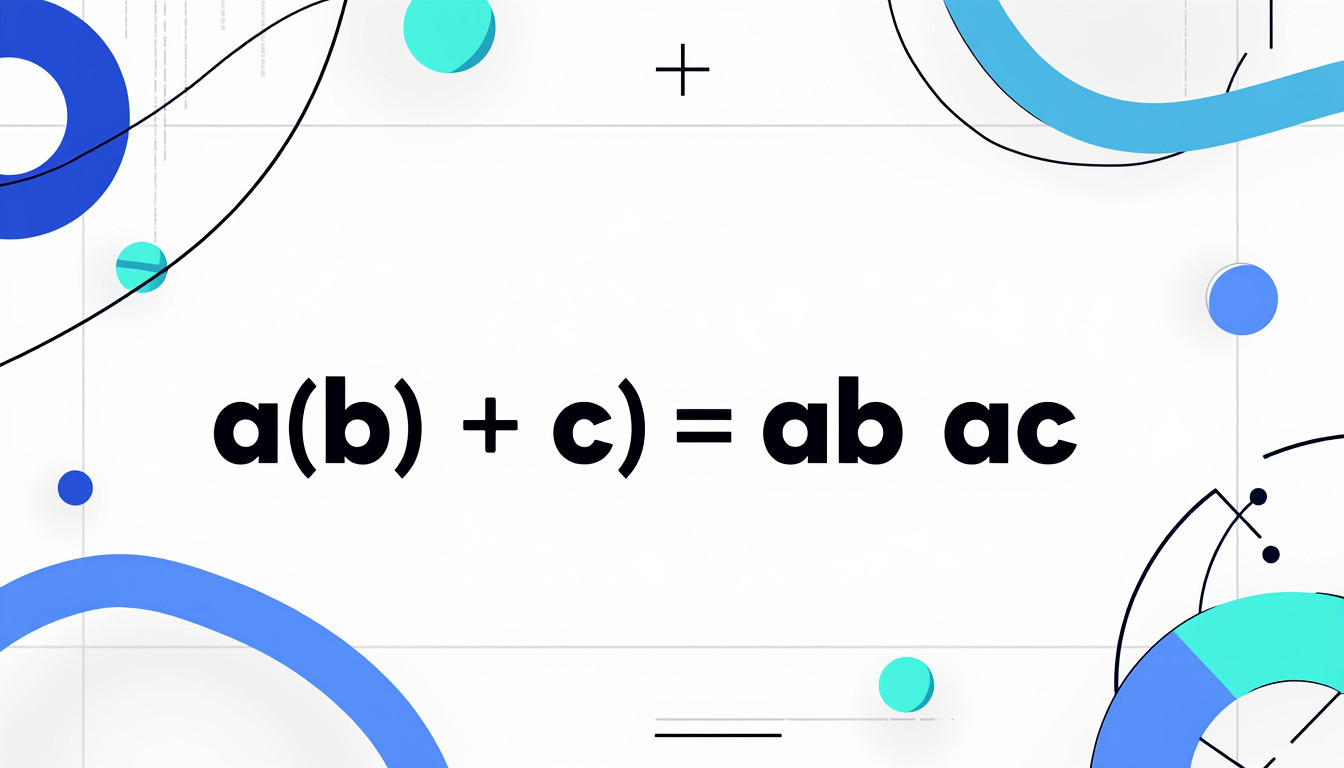
At the heart of algebra lies the necessity to simplify and solve expressions that combine various operations. One of the most effective tools for this purpose is the distributive property, which demonstrates how multiplication can be applied over addition or subtraction within parentheses. This principle states that multiplying a number by a sum or difference is equivalent to multiplying each term individually and then performing the addition or subtraction.
For example, consider the expression 4(3 + 5). Instead of first adding 3 and 5 to get 8 and then multiplying by 4, the distributive property allows us to multiply 4 by each term within the parentheses separately and then add the products: (4 × 3) + (4 × 5) = 12 + 20 = 32. Both methods yield the same result, but the distributive property often offers a clearer path, especially when variables are involved.
This property proves invaluable when working with algebraic expressions containing variables. For instance, in 6(x + 7), the distributive property lets us multiply 6 by x and 6 by 7 separately, resulting in 6x + 42. This step is essential for tasks like expanding expressions, solving equations, and factoring, which form the foundation of algebraic manipulation. Its practical utility extends far beyond rote calculation, providing an elegant framework to understand how numbers and variables interact through multiplication and addition.
Moreover, the distributive property works with subtraction just as effectively as with addition. Expressions such as 5(10 – 3) can be broken down into (5 × 10) – (5 × 3) = 50 – 15 = 35. Recognizing this interplay helps learners avoid common errors and fosters an intuitive grasp of algebraic transformations.
Understanding this property also assists in working with equations as one can distribute multipliers across grouped terms, simplifying and isolating variables efficiently. This simplifies even complex calculations, making algebraic problem-solving more accessible and less intimidating. To explore more about the distributive property’s applications in algebra, resources like this comprehensive guide offer detailed explanations and examples that deepen conceptual understanding.
Real-World Application of the Distributive Property in Simplification
Consider a scenario where a real estate investor uses algebraic equations to calculate potential earnings across multiple properties. Suppose the investor determines the monthly income from rental units is expressed as 8(x + 200), where x represents an unknown base amount per unit, and 200 is a constant fee. Using the distributive property, the income for all 8 units can be calculated as 8x + 1600. This simplifies further strategic decisions, allowing the investor to easily project income increments as x changes.
In more technical terms, the distributive property permits breaking down laborious calculations into manageable fragments, optimizing computational efficiency in sectors such as finance, engineering, and data science. For instance, when handling complex neural networks or large-scale financial models, expressing multiplicative relationships through distributed addition expedites the calculation process.
One significant merit of the distributive property is its ability to foster mental math skills. By decomposing numbers and expressions systematically, individuals can perform calculations in their heads, bypassing cumbersome arithmetic steps. This advantage demonstrates the inherent connection between algebraic principles and day-to-day problem-solving, thereby enhancing overall numeracy and confidence in mathematics.
Commutative and Associative Properties: Foundations Complementing Distributive Property
While the distributive property forms a bridge between multiplication and addition, the commutative and associative properties serve foundational roles in transforming how we approach calculations. The commutative property asserts that the order of addition or multiplication does not impact the outcome; for example, 5 + 9 equals 9 + 5. This flexibility allows for arbitrary rearrangement of terms for easier grouping and computation.
Similarly, the associative property states that when adding or multiplying, the grouping of numbers does not change the result, such as (2 + 3) + 7 = 2 + (3 + 7). This property enables shifting parentheses in expressions, enhancing how we simplify and calculate sums or products. Combining these properties with the distributive property creates a robust framework for algebraic simplification.
Take an expression like 3 × (4 + 5) × 2. Applying the associative and distributive properties strategically can break down this expression: By first distributing 3 over the sum, we get 3 × 4 + 3 × 5 = 12 + 15. Then, applying the associative property, multiply the result by 2: (12 + 15) × 2. Finally, this simplifies to 27 × 2 = 54. The sequence and grouping of operations significantly improve the mental cálculation process.
Understanding these properties in tandem contributes to efficient factorization, expansion, and simplification of algebraic expressions. Their combined use is essential for solving equations and for higher mathematical explorations such as polynomial manipulation, which relies heavily on these principles.
| Property | Definition | Example |
|---|---|---|
| Commutative Property | Order of addition or multiplication does not affect the result | 7 + 5 = 5 + 7; 4 × 6 = 6 × 4 |
| Associative Property | Grouping of numbers can be changed without changing the sum or product | (2 + 3) + 4 = 2 + (3 + 4); (3 × 5) × 2 = 3 × (5 × 2) |
| Distributive Property | Multiplication distributes over addition or subtraction | 5(2 + 3) = 5×2 + 5×3 |
To further develop mastery of these concepts and see their varied applications, exploring resources such as this thorough overview offers comprehensive insights and practice problems useful in solidifying understanding.
Breaking Down and Expanding Algebraic Expressions Using Distribution
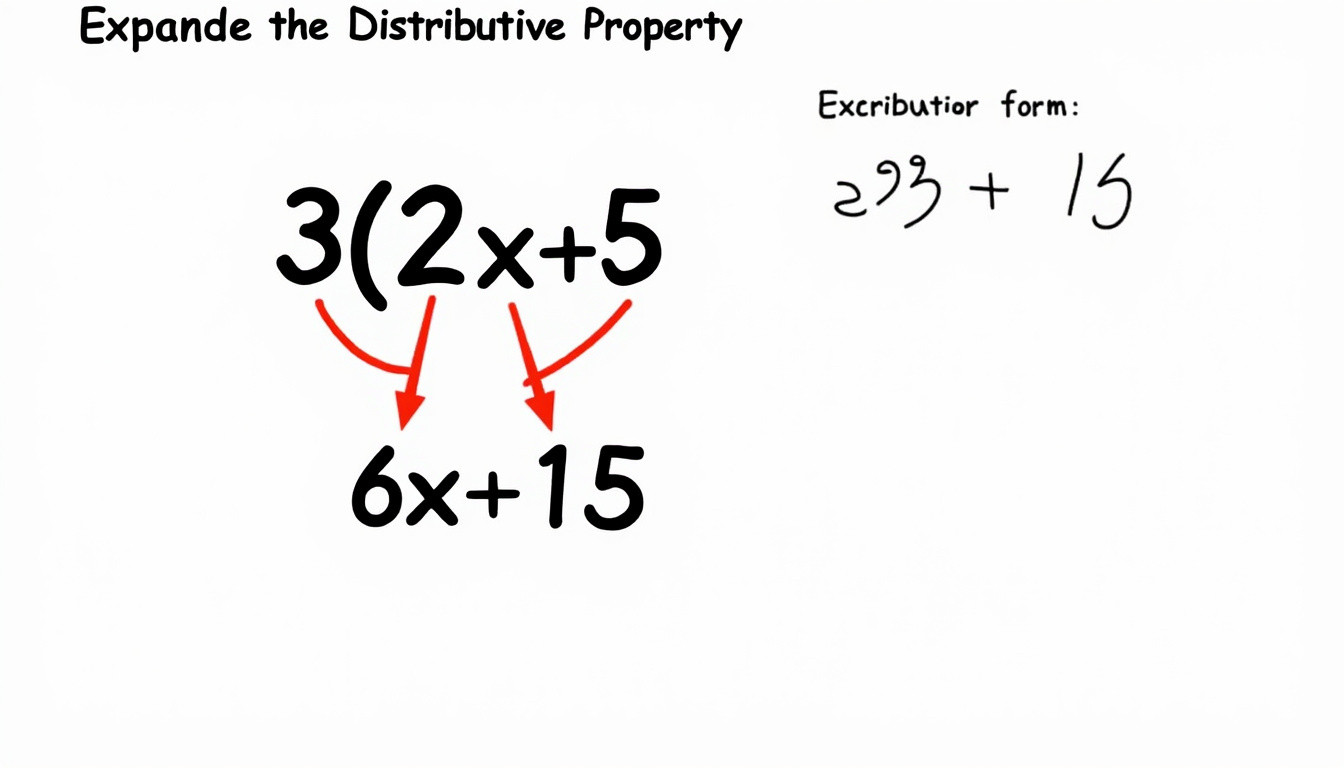
Expanding algebraic expressions is one of the most direct applications of the distributive property. When given an expression such as 7(x + 3), students and mathematicians alike can distribute the multiplier “7” across the terms inside the parentheses, obtaining 7x + 21. This transformation is essential for simplifying expressions, solving equations, and factoring.
Expanding becomes more intricate but follows the same logic when multiple variables are involved. Consider an expression like 4(2x + 5y). Distributing 4 to both 2x and 5y leads to 8x + 20y, breaking down the problem into simpler terms that are easier to handle. This process underpins critical algebraic operations and prepares learners to handle more advanced topics like polynomial multiplication.
One of the significant advantages of using the distributive property for expansion is its role in combining like terms. For example, after expanding expressions, terms with the same variables and exponents can be combined to simplify the equation further, such as turning 3x + 12x into 15x. This approach is foundational for clearer expression manipulation in algebra and supports strategic equation solving.
Moreover, their use equips learners to tackle factorization tasks, where recognizing distributed terms helps reverse the process and extract common factors. Mastery over expanding and factoring expressions using the distributive property creates a vital skill set widely applicable in algebra.
Example: Expanding and Simplifying Using Distribution
Suppose an expression 5(3x + 4) is to be simplified. Using the distributive property, this calculates as:
- 5 × 3x = 15x
- 5 × 4 = 20
Resulting in the simplified expression 15x + 20.
From here, problems involving setting the expression to equal zero or another value become easier to manage, as the expression is now fully expanded and simplified.
Using the Distributive Property in Complex Calculations and Equations
As calculations grow more complex, especially in algebra with variables, constants, and multiple operations, the distributive property emerges as a strategy to manage and simplify problems effectively. It allows one to rewrite expressions by distributing multiplication over addition or subtraction, maintaining equality while reducing algebraic complexity.
For example, solving an equation like 2(3x + 5) = 16 becomes straightforward with distribution. By transforming it to 6x + 10 = 16, the problem simplifies into a standard linear equation. Isolating the variable follows traditional methods, but it is the application of the distributive property that makes this transition possible.
Additionally, the distributive property is an essential element in factorization, where expressions are rewritten in product form. For instance, rewriting 12x + 18 as 6(2x + 3) involves recognizing common factors and regrouping terms using distributive principles. This ability is especially useful in solving quadratic equations and polynomial division.
Such applications uphold the property not just as an abstract rule but as a powerful tool that enables deeper problem-solving agility. Whether in educational settings or advanced mathematical modeling, leveraging distributive principles enhances accuracy and efficiency.
| Calculation Step | Expression | Explanation |
|---|---|---|
| Original equation | 2(3x + 5) = 16 | Equation before applying distributive property |
| Distribute 2 | 6x + 10 = 16 | Multiply 2 with both terms |
| Subtract 10 | 6x = 6 | Isolate the term with variable |
| Divide both sides | x = 1 | Find solution for x |
The distributive property thus streamlines the path from complex expressions to concrete solutions, bridging abstract algebraic concepts with practical execution. For learners looking to deepen their grasp, resources like this article provide detailed insights on distributive strategies and their real-life applications.