
Mastering the properties and identities in mathematics is fundamental to enhancing problem-solving skills. These foundational concepts empower learners to manipulate and simplify complex expressions, solve equations efficiently, and recognize patterns within algebraic structures. As we navigate the world of real numbers, variables, and equations, understanding these principles acts as a compass, guiding the thought process toward effective solutions.
The landscape of math education and application in 2026 emphasizes not only rote learning but also deep comprehension of underlying structures such as the associative, commutative, and distributive properties. With these tools, students and professionals alike can dismantle intricate problems into manageable components. These properties, combined with identities that leave values unchanged under specific operations, are crucial in algebraic simplification, revealing patterns, and providing clarity in expressions involving variables.
Key Points:
- The properties of numbers and identities simplify algebraic expressions and facilitate solving equations.
- Recognizing patterns formed by these rules is crucial in working efficiently with variables and complex expressions.
- The associative, commutative, and distributive properties, along with identity properties, serve as building blocks for higher-level math understanding.
- Practical examples and methodical use of these properties accelerate problem-solving across various mathematical domains.
- In-depth knowledge of these concepts is supported by numerous resources, including interactive worksheets and educational videos.
Exploring Core Mathematical Properties: Associative, Commutative, and Distributive Principles
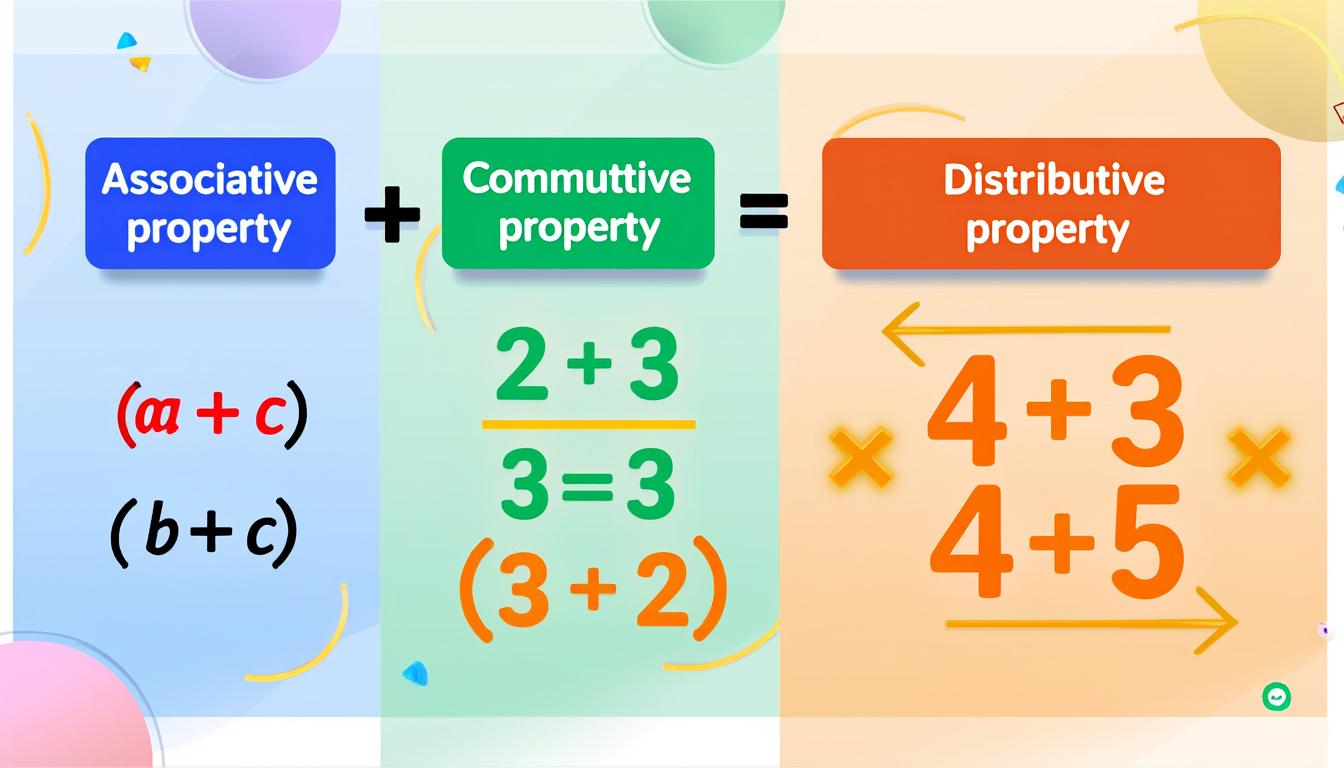
In the realm of algebra, three properties — associative, commutative, and distributive — form the pillars for simplifying expressions and solving problems. Mastering these properties is indispensable for understanding how numbers and variables interact within equations.
The commutative property dictates that for addition and multiplication, the order in which numbers are combined does not change the result. For example, 3 + 5 equals 5 + 3, and 4 × 7 equals 7 × 4. This flexibility is often taken for granted but is foundational when rearranging terms to simplify expressions or when factoring.
Moving to the associative property, the grouping of numbers can be altered without affecting the outcome. Whether adding or multiplying, expressions like (2 + 3) + 6 and 2 + (3 + 6) yield the same sum, demonstrating that the way terms are bracketed is flexible. This property is especially useful when dealing with multiple variables and complex algebraic structures.
Perhaps the most powerful is the distributive property, allowing multiplication of a term across a sum inside parentheses. This property states that a(b + c) = ab + ac. Understanding this not only aids in expanding expressions but also in factoring, solving equations, and simplifying algebraic fractions.
To illustrate, consider simplifying 4(7 + 5). Applying the distributive property, this expands into 4 × 7 + 4 × 5, which equals 28 + 20, resulting in 48. Recognizing how these properties play together enhances confidence and accuracy in problem solving.
Extensive educational materials, such as those found on associative, commutative, and distributive properties, provide comprehensive explanations and problems to practice these crucial principles. Regular practice using these resources builds fluency and speeds up algebraic manipulations.
Understanding Identities in Algebra: Additive and Multiplicative Foundations
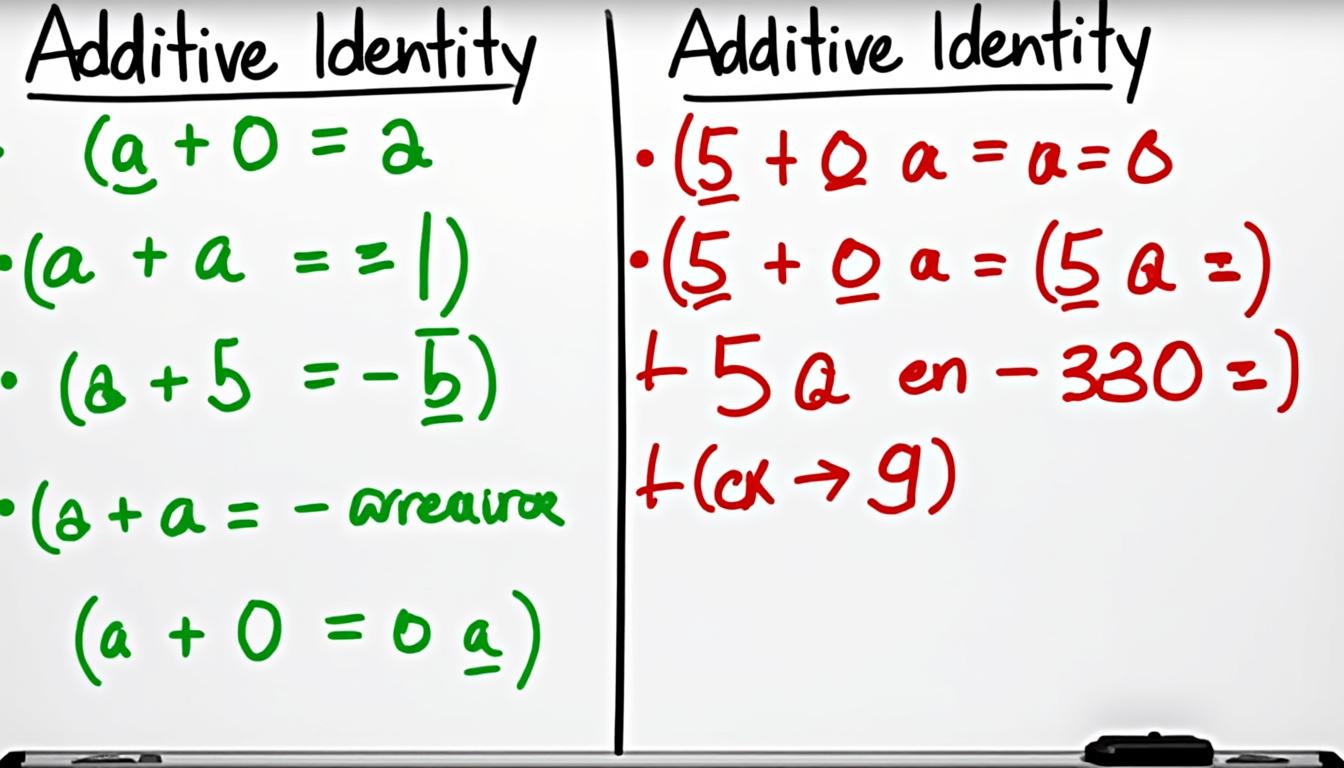
Identities in algebra refer to special numbers that, when combined with any other number using a particular operation, leave that number unchanged. Grasping these identity properties is key to unlocking elegant solutions to many algebra problems.
The additive identity is zero; adding zero to any number does not alter its value. For example, 8 + 0 remains 8. This simple rule underlies many algebraic simplifications and explains why zero plays a unique role in equations. In contrast, the multiplicative identity is one; multiplying any number by one returns the number itself, such as 7 × 1 = 7.
Recognizing these identities is crucial when solving equations because they allow certain terms to be eliminated or maintained without change. For instance, in a complex expression, identifying additive identities can help discard unnecessary zero terms, streamlining the equation quickly.
Consider the expression (3 + 9) + (-9). Since 9 and -9 are additive inverses, they cancel each other out, simplifying the expression to 3. This example also introduces the concept of inverse properties, which you will find closely related to identities.
Detailed guides explain the application and significance of identity properties in algebra. Resources like the identity property and its role in algebra provide valuable insights into how these concepts facilitate problem solving and simplification in equations and expressions.
Inverse Properties and Their Role in Simplifying Algebraic Equations
Building on identities, inverse properties form the backbone of solving equations by effectively ‘undoing’ operations to isolate variables. Understanding additive inverses and multiplicative inverses is essential for managing equations with unknowns.
The additive inverse for a number is its opposite; when a number and its additive inverse are added together, the sum is the additive identity — zero. For example, the additive inverse of 7 is -7 since 7 + (-7) = 0. This property allows one to move terms from one side of an equation to the other, maintaining balance.
Similarly, the multiplicative inverse (or reciprocal) of a non-zero number is a number which, when multiplied by the original, yields the multiplicative identity — one. For example, the reciprocal of 5 is 1/5, as 5 × 1/5 = 1. Multiplicative inverses are vital for solving equations involving multiplication and division of variables.
In practice, when presented with a fraction like 3/4 × (7/9 × 4/3), recognizing how multiplicative inverses cancel terms can simplify the expression to 1. These strategies reduce complexity and expedite arriving at solutions.
For those keen on mastering these techniques, lessons on algebraic properties including inverses offer step-by-step walkthroughs and exercises to build this indispensable knowledge.
Applying Properties and Identities to Recognize Patterns in Algebraic Expressions and Equations
The ability to recognize patterns in algebraic expressions is enhanced significantly through a solid understanding of properties and identities. Patterns often emerge when variables and coefficients interact under addition, multiplication, or factoring.
For instance, knowing the distributive property allows one to factor expressions such as 100[0.23 + (-1.78)] into 100 × 0.23 + 100 × (-1.78). Noticing such structures speeds up simplification and transformation of expressions, critical for problem solving and equation manipulation.
Examples of common patterns include the sum and difference of squares, perfect square trinomials, and factoring by grouping. Each relies heavily on applying the properties of real numbers effectively. When a pattern is identified, it unveils a strategic pathway to simplifying or solving the problem at hand.
This strategic vision is indispensable in fields like engineering, economics, and computer science, where algebraic modeling facilitates complex system understanding. The mathematical fluency to spot and leverage these patterns directly affects analytical efficiency.
Practice tools, such as interactive worksheets found on properties identifying practice, help reinforce pattern recognition skills through repetitive and varied problems.
The Impact of Properties and Identities on Simplification and Effective Problem Solving Strategies
Simplification in algebra is the process of rewriting expressions or equations in a cleaner, more workable form. This is pivotal for problem solving as it reduces cognitive load and clarifies the path to a solution.
Using properties such as the associative, commutative, and distributive, alongside identities and inverses, mathematicians can transform seemingly complex equations into simpler equivalents. This skill reduces errors and enhances the speed of calculations.
Consider the expression 8 – (11 + 6). Applying the distributive property, the expression becomes 8 – 11 – 6, which simplifies further to -9. This straightforward approach contrasts sharply with more cumbersome strategies that might attempt direct evaluation without property application.
A useful approach is to memorize and internalize key properties and identities as mental tools. This approach encourages an intuitive sense of when and how to apply each property in various contexts — essentially harnessing the building blocks of algebra to construct neat solutions.
Below is a table summarizing essential properties and their practical implications for algebraic problem solving:
| Property | Definition | Example | Problem Solving Role |
|---|---|---|---|
| Commutative Property | Order of addition or multiplication doesn’t affect outcome | 4 + 9 = 9 + 4 | Rearranging terms for easier factoring or simplification |
| Associative Property | Grouping of numbers does not change the sum or product | (2 + 3) + 6 = 2 + (3 + 6) | Facilitates grouping for addition or multiplication operations |
| Distributive Property | Multiplication over addition distributes across terms | 3(4 + 5) = 3×4 + 3×5 | Expanding expressions and factoring |
| Additive Identity | Adding zero leaves the number unchanged | 7 + 0 = 7 | Eliminating zero terms in equations |
| Multiplicative Identity | Multiplying by one leaves the number unchanged | 9 × 1 = 9 | Preserving values during algebraic manipulations |
| Additive Inverse | Adding a number and its opposite results in zero | 6 + (-6) = 0 | Solving equations by moving terms |
| Multiplicative Inverse | Multiplying a number by its reciprocal results in one | 5 × 1/5 = 1 | Isolating variables in multiplication or division |
Engaging with structured problem-solving techniques that lean on these properties is more than academic exercise — it is a critical step toward mastering algebra efficiently and confidently.