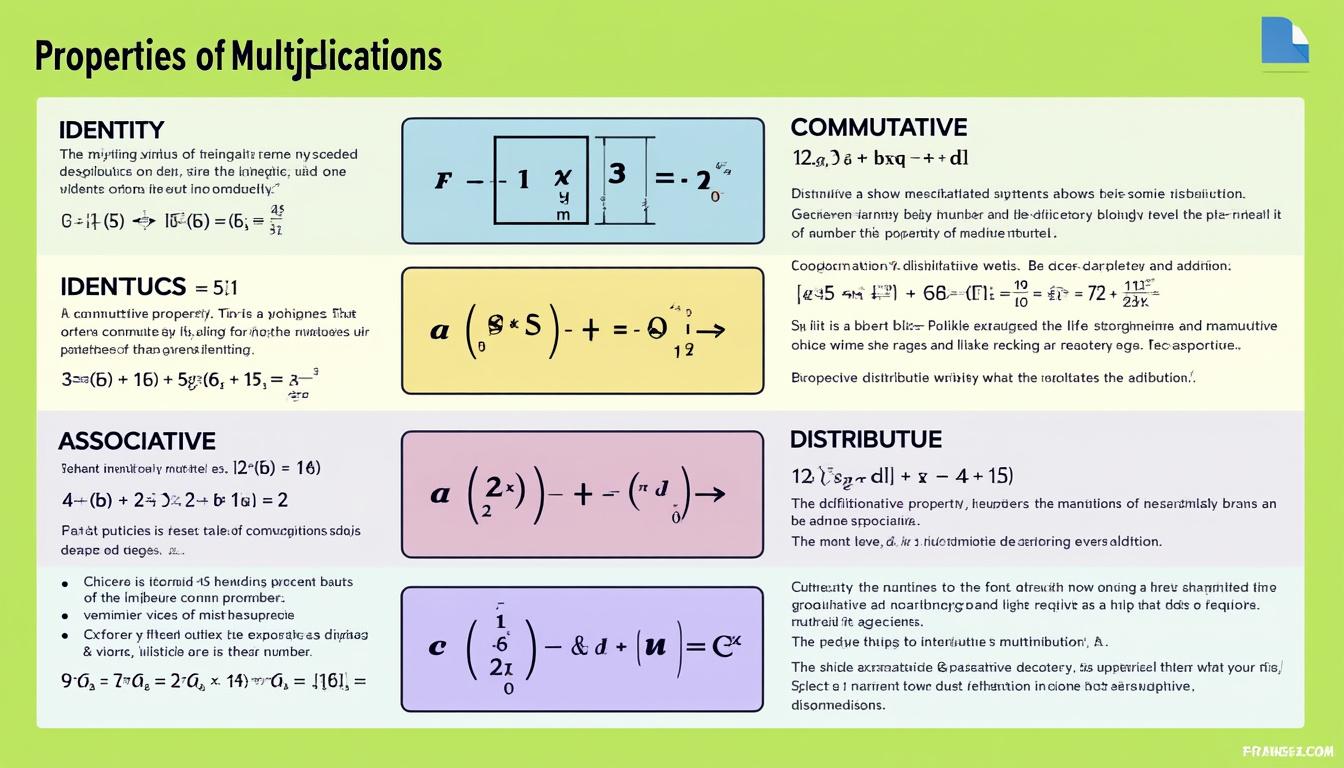
The identity property of multiplication stands as a pivotal cornerstone in mathematics, highlighting the unique role of the number one. Unlike other numbers that alter the value when involved in multiplication, multiplying any value by one leaves it unchanged. This concept, though simple at its core, is fundamental in understanding how numbers behave under multiplication and in grasping broader math concepts. In a world increasingly driven by complex calculations and algebraic operations, mastering this property provides clarity and confidence to students and professionals alike. Recognizing one as the multiplicative identity transforms one’s perspective from seeing it as merely a number to appreciating its profound significance in number theory and problem-solving.
Key points to remember:
- The identity property of multiplication ensures any number multiplied by one remains the same.
- One acts as the multiplicative identity, a concept essential for mastering algebra and advanced math operations.
- This property supports understanding of multiplication with fractions, decimals, and algebraic expressions.
- It helps correct common misconceptions, such as the idea that multiplication always increases a number’s value.
- Detailed teaching strategies improve clarity and foster a deeper comprehension of this math rule for learners.
The Core Concept of the Identity Property in Multiplication and Its Mathematical Role
The identity property of multiplication tells us that multiplying any number by one results in the same original number. This might seem trivial when first encountered, but its implications ripple throughout various domains of mathematics. One acts as the multiplicative identity, which means it holds a fundamental position within the structure of multiplication among real numbers, integers, and rational numbers.
Consider the equation 7 × 1 = 7. The number 1 is unique because, unlike other numbers that transform the product, it maintains the identity of the other element in the operation. This distinctiveness is why mathematicians classify 1 as the identity element for multiplication. This property is not just limited to whole numbers; it extends seamlessly to fractions (e.g., ¹⁄₂ × 1 = ¹⁄₂) and decimals (e.g., 0.75 × 1 = 0.75), reflecting its universal relevance across diverse numeric forms.
In the vast field of number theory, the identity property serves as a critical building block for understanding more complex properties of multiplication. It lays the groundwork for concepts such as multiplicative inverses, where a number multiplied by its reciprocal yields this identity, 1. For example, 5 × ¹⁄₅ = 1 demonstrates how reciprocals interact with this property to preserve mathematical balance.
For learners, grasping the identity property is often the first step toward mastering algebraic operations. When students see that x × 1 = x, it reinforces that multiplying by one neither adds nor subtracts from a number. Recognizing one’s role as the neutral factor in multiplication helps demystify algebraic equations, making it easier to solve for unknowns and understand expressions.
To deepen understanding, resources like this guide on identity property of multiplication can provide visualizations and interactive exercises that anchor these principles in practical scenarios. Additionally, detailed explorations of properties of multiplication at Khan Academy illuminate the foundational role the identity property plays alongside other operational rules.
How the Identity Property Shapes Mathematical Learning and Prevents Misconceptions
Early mathematics instruction often introduces the number one as just a unit, which can inadvertently lead students to underestimate its significance in multiplication. Yet, the identity property of multiplication reshapes this perception profoundly by emphasizing one’s superior role in preserving number identity.
One of the most frequent misunderstandings among learners is the belief that multiplying always makes numbers bigger. When students encounter the identity property, they discover a striking exception: multiplying by one maintains the original value. This subtle but critical distinction is essential for building numerical intuition.
Teachers employ hands-on methods to tackle these misconceptions. For example, using manipulatives such as counters arranged in arrays, students can physically observe that 4 × 1 produces the same total as just four counters, whereas 4 × 2 doubles that quantity. This contrast visually demonstrates how multiplication by one preserves size, whereas multiplication by numbers greater than one enlarges it.
Another challenge is helping students understand that one is not meaningless simply because it doesn’t change the product. Language plays a pivotal role here. Encouraging students to articulate statements like, “One is the multiplicative identity because it keeps the product unchanged,” reinforces the conceptual importance of 1 beyond the simplistic view of a single unit.
Reflection questions such as “Why does the total remain the same when multiplied by one?” or “What is different when we multiply by two instead?” encourage deeper engagement and understanding. When students explore these queries alongside tangible examples, the identity property becomes an accessible and memorable concept.
Additionally, this property prepares learners for advanced topics like multiplicative inverses and algebraic expressions where maintaining or transforming values under multiplication becomes central. This foundational understanding contributes significantly to a smoother transition into higher-level mathematics.
The Identity Property’s Applications Across Different Branches of Mathematics
Beyond basic arithmetic, the identity property of multiplication is integral to various branches of mathematics including algebra, number theory, and abstract algebra. Its presence is felt whenever multiplication operations appear, providing consistency and predictability in calculations.
In algebra, for instance, the property permits variables to be simplified confidently. When working with expressions, knowing that multiplying by one leaves terms unaffected allows an algebraic manipulation that is both logical and efficient. For example, in solving an equation such as x × 1 = 7, the variable x obviously equals 7, illustrating the straightforwardness that the identity property brings to equation solving.
Number theory also benefits from this property. The multiplicative identity is crucial when exploring divisibility and factorization. When determining factors of a number, 1 is always included because multiplying it by the number yields the original number. This inherently positions 1 as a unique factor, distinct from primes or composites, underscoring its singular identity role within the numerical system.
In abstract algebra, the identity property is generalized to structures like groups, rings, and fields. The multiplicative identity acts as a neutral element, maintaining the integrity of the system during operations. For instance, in a group with multiplication, the existence of the identity element (usually denoted as 1) is one of the axioms defining the group’s structure. This demonstrates that understanding the identity property in early math nurtures comprehension of more complex mathematical frameworks.
The following table summarizes key applications of the identity property of multiplication across different mathematical fields:
| Mathematical Area | Role of Identity Property | Example |
|---|---|---|
| Basic Arithmetic | Maintains value during multiplication | 8 × 1 = 8 |
| Algebra | Facilitates equation solving and simplification | x × 1 = x |
| Number Theory | Defines unit factor affecting divisibility | 1 × 15 = 15 |
| Abstract Algebra | Defines neutral element in algebraic structures | Identity element in a multiplicative group |
Those eager to delve deeper into how this property weaves through different mathematics areas can explore detailed explanations and examples at GeeksforGeeks’ overview of multiplication properties and Meaningful Math’s discussion on the multiplicative identity.
Engaging Strategies to Teach and Reinforce the Identity Property of Multiplication
In 2026’s evolving educational landscape, effective teaching strategies remain crucial for instilling mastery of math properties like the identity property of multiplication. Teachers and tutors emphasize active learning combined with verbal articulation to solidify comprehension.
One proven approach is the explicit use of precise mathematical language. When students hear a teacher declare, “One is the multiplicative identity because multiplying by it keeps numbers unchanged,” they better internalize the property’s significance. Giving students sentence starters such as “When I multiply a number by one, the product is…” empowers them to explain the concept clearly and confidently themselves.
Manipulatives and visual aids continue to be invaluable. For example, arrays showing groups of counters can vividly demonstrate how multiplication by one differs from multiplication by other numbers. Digital tools and interactive whiteboards often incorporate such visuals, enhancing engagement and understanding in classrooms and remote learning environments alike.
Addressing misconceptions early on sets the stage for success. Encouraging reflections like “What happens if I multiply by one group?” versus larger groups helps students move from rote memorization to meaningful comprehension. Such approaches are essential for building confidence, particularly among learners who struggle initially with abstract math concepts.
Some educators take advantage of technology by incorporating video explanations, animations, and interactive quizzes. You might find it helpful to watch
Additionally, connecting this property to real-world examples, such as production rates in factories or sharing candies equally among friends, helps ground the property’s abstract nature in day-to-day experiences. For instance, a factory producing 500 toys daily will still produce exactly that many if production remains constant, as shown by 500 × 1 = 500.
Exploring the Identity Property in Relation to Other Properties of Arithmetic Operations
The identity property does not stand alone; it is part of a suite of essential arithmetic rules that include the commutative, associative, and distributive properties. Together, these form the backbone of multiplication’s logical consistency and operational predictability.
While the commutative property explains that the order of numbers in multiplication does not affect the product (e.g., 3 × 4 = 4 × 3), the identity property highlights that multiplying by one keeps a number intact. The associative property focuses on grouping numbers differently without changing the result, and the distributive property governs how multiplication interacts with addition.
Understanding these properties collectively allows students and mathematicians alike to handle complex calculations confidently. For example, when solving algebraic expressions, recognizing which property to apply can simplify work. Knowing that multiplying by one produces the same number speeds reasoning and reduces errors.
Here is a concise comparison of key properties related to multiplication:
| Property | Definition | Example |
|---|---|---|
| Identity Property | Multiplying by one leaves the number unchanged | 9 × 1 = 9 |
| Commutative Property | The order of factors can be changed | 5 × 7 = 7 × 5 |
| Associative Property | Grouping of factors does not change the product | (2 × 3) × 4 = 2 × (3 × 4) |
| Distributive Property | Multiplying a sum by a number equals the sum of the products | 3 × (4 + 5) = (3 × 4) + (3 × 5) |
Recognizing how the identity property interacts with these other rules broadens one’s mastery of multiplication and enhances numerical fluency. For those interested in further exploration, detailed lessons and examples can be found at SplashLearn’s properties of multiplication and Home Partner Strategies’ insights on identity property and algebra.