
The transitive property is a cornerstone in mathematical reasoning and geometry, playing a vital role in the way congruence between shapes and figures is understood and proved. When delving into the concept of congruence—where two geometric objects are identical in shape and size—the transitive property ensures that relationships among these objects maintain logical consistency. This property is not just an abstract rule; it helps solve real-world problems, such as architectural design and engineering, where precision and equality are non-negotiable. This article explores which statements exemplify the transitive property of congruence, breaking down the concept through examples, proof techniques, and its applications in triangle congruence and beyond.
Key Points:
- The transitive property of congruence establishes that if two figures are congruent to a third figure, then they are congruent to each other.
- This property extends the concept of equality into geometric settings, replacing equal signs with congruence symbols.
- It is essential for proofs involving equal segments, equal angles, and congruent triangles in geometry.
- Understanding this property aids in constructing logical deductions crucial for mathematical proofs and real-world applications.
- Examples drawn from geometry demonstrate the power and necessity of the property in establishing relationships without redundancy.
Defining the Transitive Property of Congruence in Geometry
The fundamental concept behind the transitive property of congruence lies in its direct parallel to the transitive property of equality familiar in algebra: if A equals B and B equals C, then A equals C. Geometry adapts this rule to congruence, symbolized often by ≅, replacing equality signs and abstract values with geometric figures such as angles, segments, or triangles.
This means, for example, if segment AB is congruent to segment CD, and segment CD is congruent to segment EF, then segment AB must be congruent to segment EF. This principle allows mathematicians to chain congruences and make logical deductions necessary to prove more complex statements without reevaluating every pair from scratch. Its role is crucial in confirming proof sequences that involve multiple congruent objects.
Take the study of triangle congruence criteria like Side-Angle-Side (SAS) or Angle-Side-Angle (ASA). The transitive property allows the conclusion that if two triangles are separately congruent to a third triangle based on these criteria, then they must be congruent to each other. This reliability encourages streamlined arguments in proofs and problem-solving situations.
Unlike the reflexive or symmetric properties of congruence which address a figure’s relationship with itself or with another figure in reverse, the transitive property links multiple congruences in a chain, creating an efficient logical bridge between them.
For more detailed explanations and examples of this property, one can consult in-depth resources such as tutors.com’s discussion on the transitive property of congruence which offers accessible lessons for students and learners.
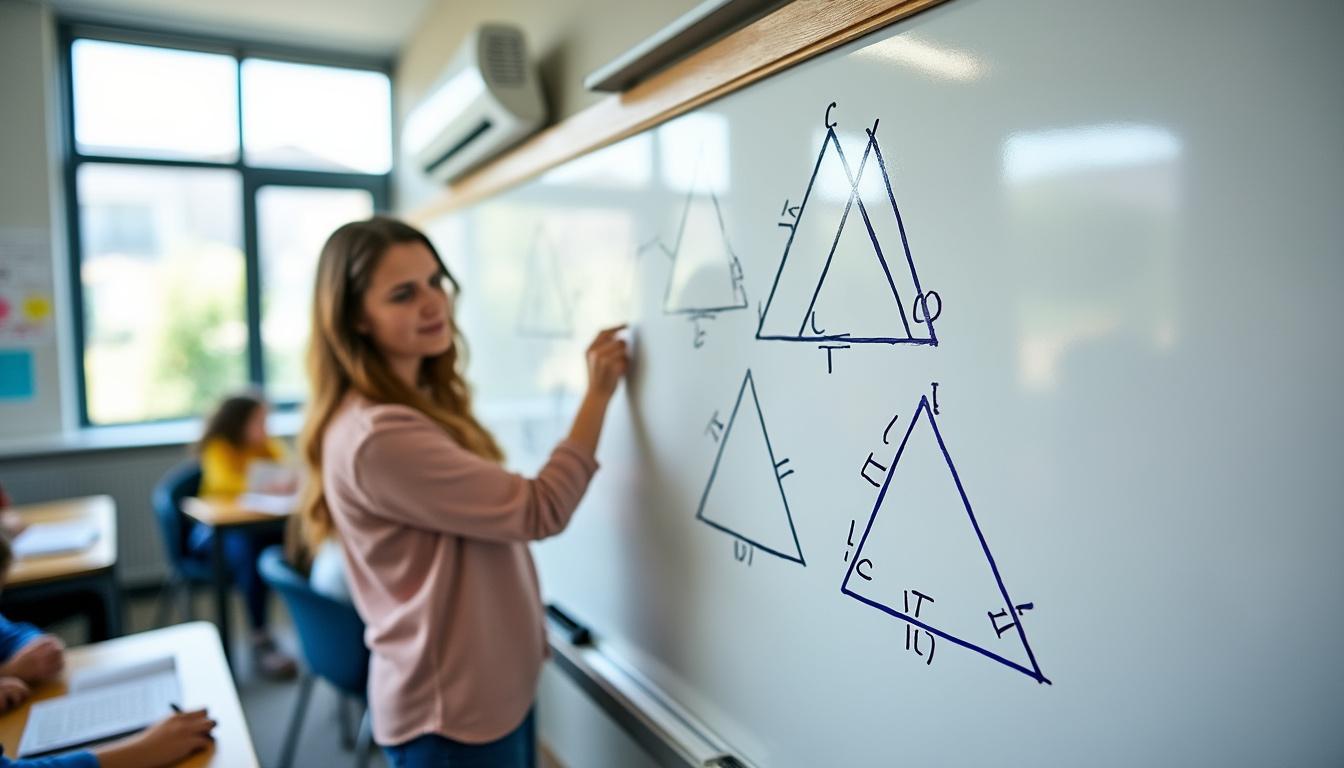
Examples Illustrating the Transitive Property of Congruence in Practical Geometry
Examples help ground the abstract nature of the transitive property of congruence into tangible cases where it clearly applies. Consider three angles: ∠A, ∠B, and ∠C.
Suppose ∠A ≅ ∠B and ∠B ≅ ∠C. Logically, it follows that ∠A ≅ ∠C. This setup reflects the transitive property of congruence applied to angles, aiding proofs in problems dealing with polygons or circle theorems where angle relationships dictate outcomes.
Similarly, for segments, assume two segments AB and CD are congruent (AB ≅ CD), and segment CD is congruent to EF (CD ≅ EF). This definitively states AB ≅ EF.
In proofs involving triangles, this becomes especially useful. Imagine three triangles, ΔABC, ΔDEF, and ΔGHI, with ΔABC ≅ ΔDEF and ΔDEF ≅ ΔGHI. According to the transitive property, ΔABC ≅ ΔGHI holds, saving the effort of a second separate proof. This property underpins many triangle congruence criteria used in advanced geometry.
To demonstrate the property step by step in problem solving, it is important to highlight the following points within the framework of mathematical reasoning:
- Identify pairs of congruent figures to establish initial congruences.
- Use previously proven congruences to connect new figures logically.
- Apply the transitive property to deduce the final congruence between the desired objects.
- Reinforce conclusions with diagrams or flowcharts showing the linking congruences.
The structure of such a proof often resembles:
- Given: Objects A, B, C with A ≅ B and B ≅ C.
- Show: A ≅ C by invoking the transitive property.
- Conclude: By chain of congruences, the property ensures equality in the context of geometry.
Additional examples and exercises incorporating this method can be found at Basic Mathematics’ properties of congruence page, which offers numerous geometric applications and practice problems.
Role of Transitive Property in Triangle Congruence Proofs and Logical Deduction
The concept of triangle congruence is one of the most significant areas where the transitive property shines. Triangle congruence, a fundamental topic in geometry, asserts that two triangles are congruent if their corresponding sides and angles match according to established criteria. These criteria include SSA, SAS, ASA, AAS, and the more specialized RHS (Right angle-Hypotenuse-Side).
Take the case of overlapping triangles where sides and angles are shared or congruent to parts of other triangles. Verifying the congruence of these components stepwise can be tedious unless the transitive property is employed. It enables one to reason that if one triangle matches another, which in turn matches a third, then the first and third must be congruent.
This logical deduction is invaluable, especially when constructing geometric proofs that often require chaining equal segments and angles. The transitive property adds clarity and reduces redundancy, trimming the length of proofs and solidifying their logical foundation.
Furthermore, this property ties into the broader property of equality, reinforcing consistent mathematical logic throughout various branches of mathematics. In terms of practical geometry problems, such as proving that two triangles formed from a construction are congruent or that different parts of a polygon are equal, the transitive property acts as a reliable bridge.
Learning platforms like Study.com’s lessons on properties of congruence provide thorough insights into how these proof properties interact in geometry and are a helpful resource for students tackling formal proofs.
Common Mistakes and Misconceptions About the Transitive Property of Congruence
Despite being straightforward, the transitive property is sometimes misunderstood or misapplied in geometrical reasoning. A typical error is confusing congruence with equality of measurement without verifying the established congruences first. For instance, just because two segments appear to be equal in length on a diagram does not guarantee they are congruent unless supported by a logical proof.
Another frequent mistake is trying to apply the property when one of the congruences does not exist or has not been demonstrated properly. The transitive property depends on confirmed congruences, meaning that missing or incorrect data breaks the chain of logical deduction.
Additionally, the property cannot be used to assert congruence directly between figures unless each intermediate relationship holds true. Jumping to conclusions without stepwise confirmation can lead to flawed proofs.
It’s important to remember that while the transitive property aids efficiency, it cannot replace the foundational work in proving initial congruences through methods like SAS or ASA; it is a tool for extending these initial congruences logically.
Teachers and students alike should pay close attention to these pitfalls to ensure proofs are valid, which remains essential in geometry and broader mathematical reasoning.
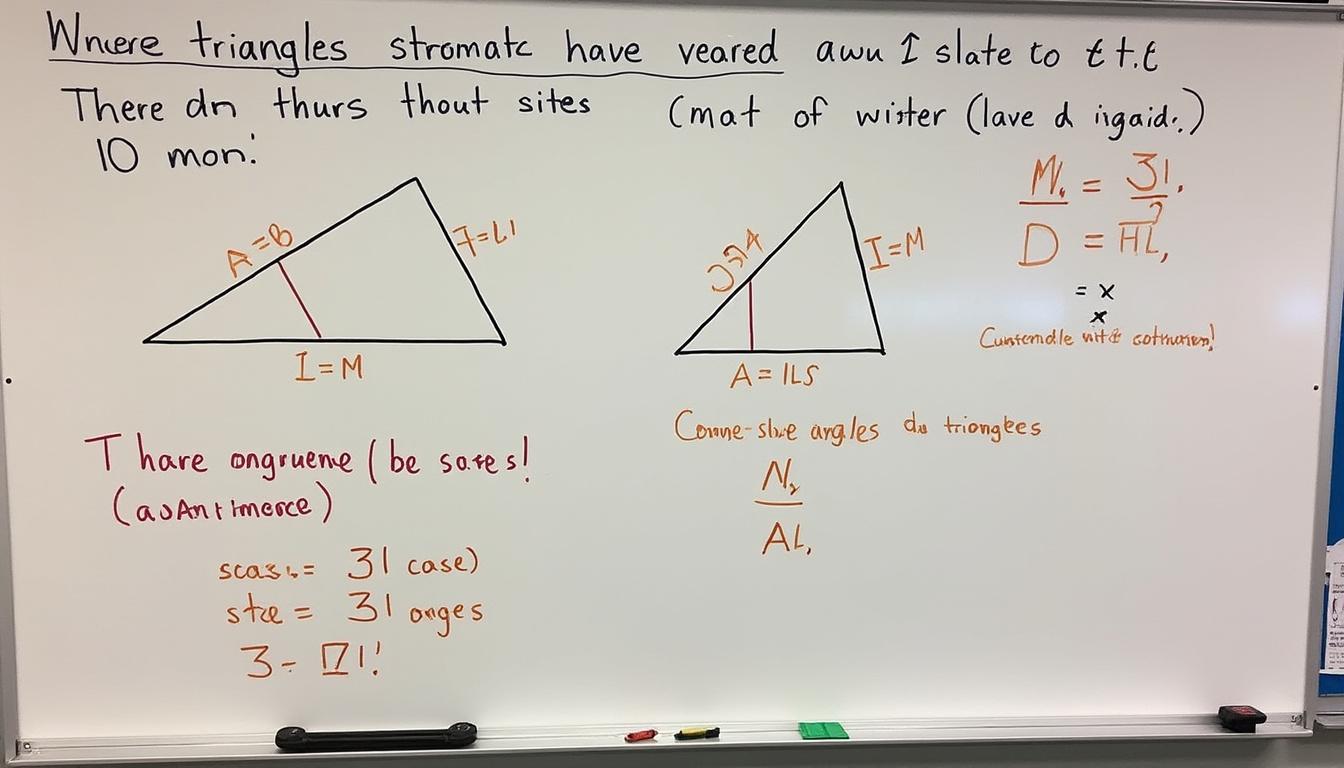
Integration of Transitive Property in Advanced Mathematics and Real-World Structures
The transitive property of congruence does not just remain confined to classroom exercises; it finds critical use in engineering, architecture, and computer graphics where equal parts must be identified and verified efficiently.
For example, modern architectural software utilizes the principles behind the transitive property to confirm that components fit together precisely, such as beams congruent to others via intermediate supports. This ensures integrity and symmetry in structural designs, which are crucial for safety and aesthetic appeal.
In computer graphics, congruent figures are essential for mesh modeling and shape transformations. The software often leverages mathematical properties like transitive congruence when simplifying models or verifying symmetry, leading to smoother animations and renderings.
In pure mathematics, the transitive property continues to underpin higher-dimensional geometric reasoning and group theory, where congruence-like relations extend beyond triangles and segments to more complex shapes and abstract algebraic structures.
| Application Area | Role of Transitive Property of Congruence | Example |
|---|---|---|
| Geometry Proofs | Linking congruent figures to simplify proofs | Proving two triangles congruent via a common third triangle |
| Architecture | Ensuring structural elements are identical or symmetric | Confirming congruent beams in bridge construction |
| Computer Graphics | Verifying symmetry and equal segments for modeling | Efficient polygon mesh simplification |
| Mathematical Theory | Extending congruences to complex forms | Applications in group theory with congruence relations |
As these examples show, the transitive property of congruence is an indispensable tool across disciplines, intertwining abstract mathematical reasoning with tangible applications.