
The addition property of equality is a cornerstone concept in algebra that empowers students and professionals alike to solve equations with confidence and accuracy. Its essence lies in the idea that adding the same value to both sides of an equation does not disturb the balance that the equation represents. This principle is fundamental for mastering algebraic operations, equation manipulation, and the broader understanding of mathematical properties that govern equal values in an equation. As 2026 brings further advancements in educational tools and approaches, grasping this property enriches one’s ability to navigate complex linear equations and achieve the isolation of variables essential for problem-solving.
In brief:
- The addition property of equality states that adding the same number to both sides of an equation maintains the equality.
- It serves as a vital operation in equation solving and manipulation in algebra.
- Applying this property helps maintain balance, akin to a scale, ensuring equations remain valid.
- It is crucial for isolating variables in linear equations, facilitating clearer solutions.
- The property extends to inequalities with similar balancing effects.
- Understanding this property builds a foundation for more advanced algebraic concepts like the multiplication property of equality.
Defining the Addition Property of Equality: Core Concepts in Algebra
At its core, the addition property of equality states that when the same value is added to both sides of an equation, the overall equality remains undisturbed. Mathematically, if you have an equation such as x = y, then adding a constant n on both sides gives you x + n = y + n, which holds true by the property’s definition. This principle operates as a safeguard that lets mathematicians perform transformations and simplifications without altering the correctness of the equation.
The importance of this property cannot be overstated in algebra. It provides the theoretical assurance that manipulation of equations through addition or subtraction of equal quantities is sound. For example, consider the linear equation 2x – 3 = 0. By adding 3 to both sides—a direct application of the addition property—you get 2x = 3. This transformation is critical to eventual isolation of the variable x and finding its value, which in this case is 3/2.
This property also plays a crucial role in arithmetic operations involving fractions, which are common in algebraic expressions. Whether we add a fraction or an integer, adding the same value to both sides will preserve equality. Its universality across different types of numbers stands as evidence of its foundational nature within the subject.
Moreover, the addition property shadows real-world situations where balance is maintained despite equal increments on both sides. Examples include financial budgeting, where adding an equal expense adjusts both income and outflow without altering net balance, or adjusting recipes where doubling an ingredient amount keeps proportions intact.
Practical Applications of the Addition Property in Equation Solving
One of the major challenges learners face in algebra is understanding how to manipulate equations without losing their equivalence. The addition property of equality provides a clear and methodical way to approach this challenge. Let’s explore how it fits into the broader scheme of equation solving.
Maintaining Equation Balance
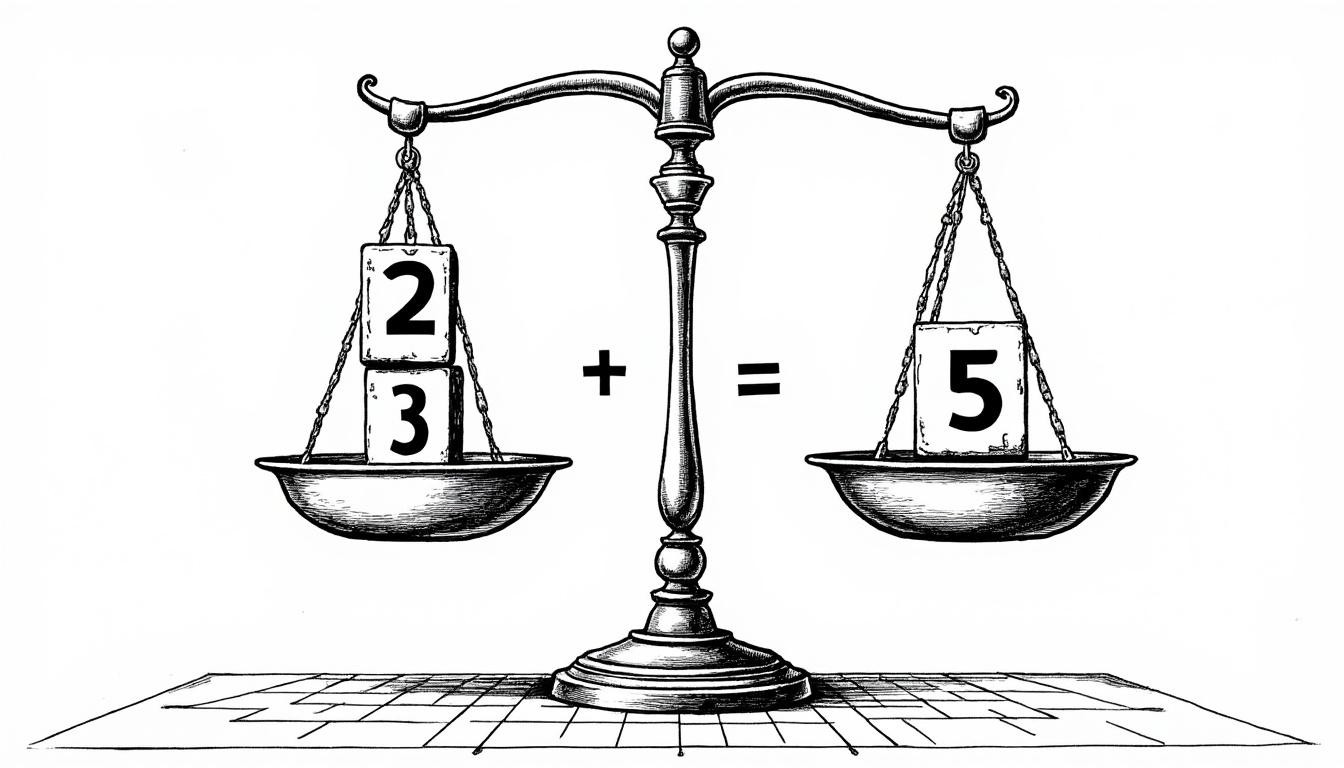
Imagine an equation as a balance scale. If you place a certain value on one side and an equal value on the other, the scale is balanced. Adding the same number to each side is like putting equal weights on both sides of the scale, which keeps it balanced. This analogy is widely used in teaching algebra because it translates an abstract concept into a visual and tangible method.
Using the Property to Isolate Variables
Consider trying to solve x – 4 = 7. To find the value of x, the goal is to isolate it on one side. By adding 4 to both sides, you use the addition property of equality to maintain the balance while simplifying the equation to x = 11. This is one of the most fundamental steps in solving linear equations and is the first operation taught in algebra classes for equation manipulation.
Examples Demonstrating Equation Transformations
Here are a few illustrative examples:
| Original Equation | Operation Applied | Resulting Equation |
|---|---|---|
| x + 2 = 5 | Add 1 to both sides | x + 3 = 6 |
| x – 1 = 3 | Add 2 to both sides | x + 1 = 5 |
| 2x – 3 = 7 | Add 3 to both sides | 2x = 10 |
Such transformations reinforce the principle that while the appearance of the equation changes, its truth value or solutions remain consistent. This principle forms the backbone of what is often called the balance method for solving linear equations.
Extending the Addition Property of Equality to Inequalities and Complex Algebraic Operations
Although the addition property primarily addresses equations, it has a close sibling in the world of inequalities. The addition property of inequality states that when the same number is added to both sides of an inequality, the inequality’s truth remains intact. For example, if a < b, then a + c < b + c. This property is essential when solving inequalities and further reinforces understanding of balanced operations in algebra.
In algebra, various operations require the manipulation of expressions to isolate variables or simplify forms. The addition property is often coupled with other algebraic properties — such as the multiplication property of equality — to systematically break down complex linear equations into solvable forms. Its role in this process embodies the concept of equation manipulation, a key skill in algebraic reasoning that builds towards advanced mathematical problem-solving tasks.
Working with fractions, decimals, or mixed numbers does not change the effectiveness of the addition property. It allows the algebraist to think flexibly, approaching problems with confidence regardless of numeric representation. For instance:
- When solving 1/2 x – 3 = 5, adding 3 to both sides uses the property to get 1/2 x = 8.
- For decimal linear equations such as 2.5x – 1.5 = 4.0, adding 1.5 to both sides achieves simplification to 2.5x = 5.5.
The versatility of the addition property thus makes it invaluable for a wide range of equation solving tasks.
Theoretical Foundations and Mathematical Language Behind the Property
The formal articulation of the addition property of equality can seem daunting for those first encountering it, but it ultimately conveys a simple truth in precise mathematical language. The theorem states that for all real numbers a, b, and c, the equality a = b holds if and only if a + c = b + c. Here, ⇔ symbolizes that both statements are equivalent and true at the same time.
This principle allows algebraic procedures to maintain truth or equivalence when certain operations are applied to equations. Understanding the meaning behind this theorem—as opposed to mere memorization—helps students develop a strong sense of logical balance that is essential to algebraic reasoning.
Breaking down the theorem into everyday terms: suppose you start with a = b. By adding a number c to both sides, the equation transforms into a + c = b + c. The property guarantees that this new equation shares the same solutions and truth as the original one. This also works in reverse: subtracting c from both sides restores the original equation and its truth.
Such understanding empowers learners to confidently perform steps in solving equations without fear of altering the solution set. The property is not just a rule but a logical foundation that keeps equation solving consistent and trustworthy.
For further exploration of this foundational property in mathematical contexts, the reader may consult resources such as insightful algebraic explanations or visit dedicated educational pages like mathematical vocabulary glossaries that contextualize the balance method and related operations on equations.
Common Challenges and Misconceptions in Applying the Addition Property of Equality
Despite its apparent simplicity, learners often encounter difficulties when first applying the addition property of equality, particularly regarding the conservation of equation balance and equivalence. One common pitfall is mistaken belief that altering only one side of the equation by adding or subtracting a value is permissible, which inevitably distorts the equation and yields incorrect solutions.
Another challenge lies in distinguishing whether two equations are truly equivalent after applying operations. For example, showing that x + 2 = 5 and x + 3 = 6 represent equivalent transformations requires recognizing the addition of 1 to both sides, whereas comparing x + 1 = 3 and x = -2 reveals nonequivalence outright.
Awareness of these nuances contributes greatly to building robust equation solving skills and encourages a more critical approach to mathematical operations. Teachers and learners alike can benefit from consistent practice problems, encouraging exploration of equation manipulation techniques while reinforcing the logical basis of the addition property.
- Always add or subtract the same number on both sides to preserve equality.
- Verify if transformed equations remain logically equivalent by tracing the operation applied.
- Use the balance scale analogy to reinforce consistent equation manipulation.
- Combine addition property steps with multiplication or division properties as needed.
- Practice with fractions and decimals to build flexibility in applying the property.