
In brief:
- Density is a fundamental physical property that quantifies the relationship between mass and volume in a material.
- It is an intensive property, meaning it does not depend on the size or quantity of the substance.
- Density helps distinguish different substances and explains natural phenomena such as floating and sinking.
- The measurement of density utilizes the formula density = mass ÷ volume, allowing versatile calculations in science and industry.
- Density transcends chemistry; it plays roles in ecology, physics, and engineering by describing concentration of mass, charge, or energy in various contexts.
Understanding why density is a core physical property in material science
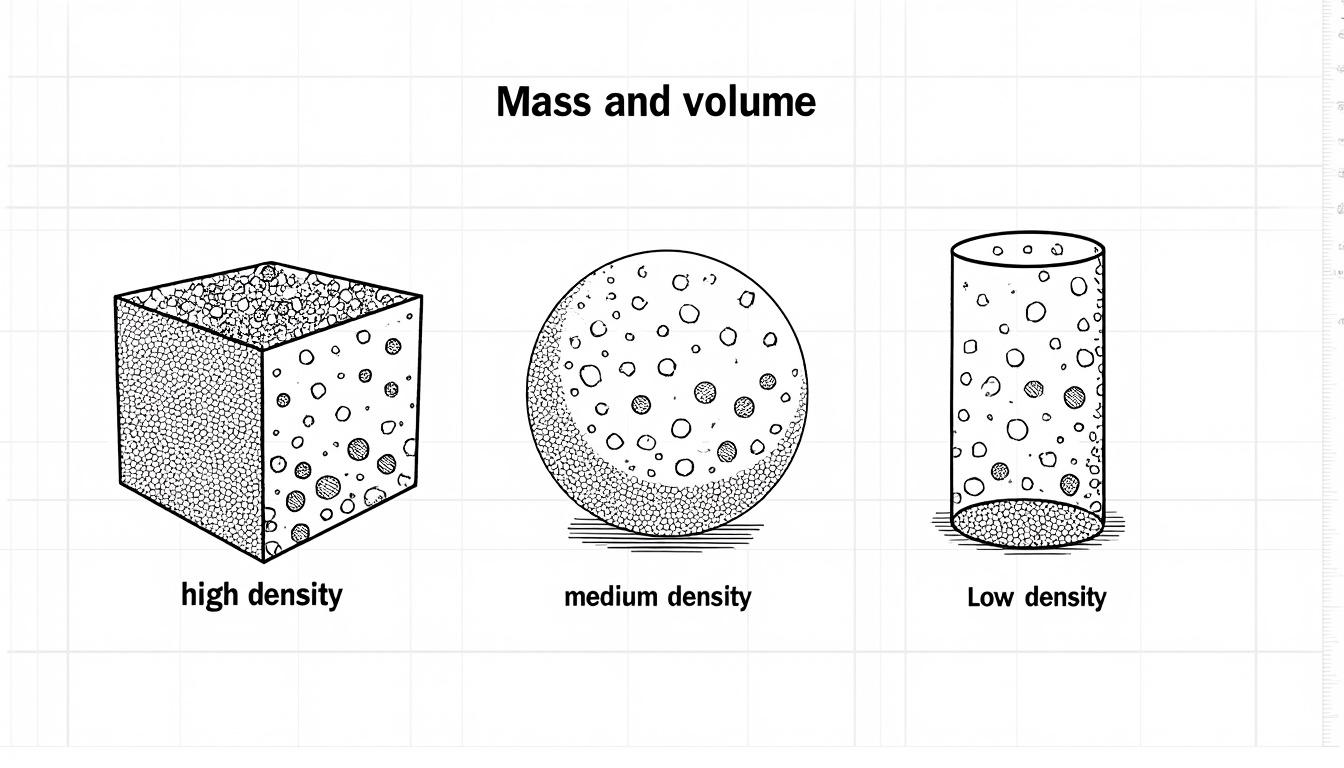
Density fundamentally expresses how much mass is packed within a certain volume of a material. When we say one object is « heavier » than another, such as oak wood versus balsa wood, we often intuitively refer to density — the mass per unit volume — rather than the total weight alone. This distinction is crucial in science and engineering because it reflects an intrinsic characteristic of a substance rather than an extrinsic factor like size.
For instance, small pieces of oak are denser than much larger pieces of balsa wood, a fact confirmed by weighing exactly one cubic centimeter of each. Physically, oak’s particles are packed more tightly, giving it a higher density value (e.g., approximately 0.71 g/cm³) compared to balsa’s 0.15 g/cm³. This ratio — mass divided by volume — is designated as density, often symbolized by ρ, a standardized measure that remains consistent regardless of sample size.
This consistency emphasizes that density is an intensive physical property: one that does not change with the amount or shape of the material. Contrast this to extensive properties like mass or volume, which vary according to the sample size. Such a property enables scientists and professionals to identify substances or compare materials efficiently — a block of aluminum will consistently show a density around 2.70 g/cm³ at room temperature, making it distinguishable from other metals.
The significance of density extends beyond laboratory measurements. Consider industry supply chains relying on the density of building materials, or environmental engineers studying pollution layers based on the density differences within liquids. This versatile physical property is one of the most practical and reliable parameters used across many fields.
How density measurement works: Practical examples and mathematical approach
At the heart of density determination lies a straightforward equation familiar to many in science: density = mass / volume. This formula allows for accurate and straightforward measurement of a material’s characteristic property by quantifying how much matter it contains in a given space.
Consider the classic example of aluminum: an irregularly shaped piece weighed 37.42 grams, which raised water in a graduated cylinder by 13.9 milliliters when submerged. According to the displacement method, this volume corresponds directly to the object’s true volume. Plugging the values into the density formula yields a density of roughly 2.69 g/mL, aligning neatly with the known standard for aluminum. This consistency reinforces the idea that density is a fixed physical property for pure substances, barring temperature or pressure variations.
Another scenario might involve calculating volume from geometric dimensions. A cylindrical aluminum sample with a radius of 0.750 cm and a height of 5.25 cm has a volume found using the formula for cylinder volume V = πr²h. With that volume and its measured mass, one can compute density, again arriving near 2.70 g/cm³. These stepwise approaches illustrate that measuring and calculating density involves sound mathematical principles traceable to fundamental physical properties.
Density values for materials vary widely, as documented in numerous scientific resources and tables, highlighting substances from gases to precious metals. For example, helium gas exhibits a density near 0.00016 g/cm³ while gold approaches 19.32 g/cm³, underscoring the diversity of material densities that reflect their fundamental particle structures and bonding arrangements.
| Material | Density (g/cm³) |
|---|---|
| Helium gas | 0.00016 |
| Water | 1.000 |
| Aluminum | 2.70 |
| Iron | 7.87 |
| Gold | 19.32 |
For scientists and researchers, these density values aren’t mere numbers; they reveal the underlying particle compactness and atomic weights. As such, density serves as a robust tool for material identification, quality control, and understanding physical behavior under different conditions.
Density versus chemical properties: Clarifying misconceptions
One frequent question in both educational and professional circles is whether density is a physical property or a chemical property. The distinction matters because it affects how density changes in relation to material composition and reactions.
Chemical properties describe how a substance’s chemical identity changes under certain reactions, such as combustibility or reactivity with acids. In contrast, density remains consistent for a substance unless its physical state or external conditions, like temperature or pressure, change.
For example, water and ice have differing densities because freezing alters the physical structure without changing the fundamental chemical composition. Ice is less dense, allowing it to float above liquid water, a rare phenomenon with critical ecological implications such as insulating aquatic life in winter. Such variations are physical state changes, not chemical transformations.
Density is measurable and quantifiable without altering a material’s inherent chemical structure, unequivocally classifying it as a physical property rather than chemical. For detailed scientific discussions on this topic, exploring sources like the comprehensive analysis at whether density is a physical or chemical property provides illuminating insights backed by rigorous chemical understanding and extensive examples.
Using density to explain everyday phenomena: Floating, sinking, and layering
Density isn’t just a laboratory curiosity; it profoundly explains natural and practical observations around us. One classic example is the behavior of liquids that do not mix, termed immiscible. When poured together, such liquids separate due to differences in density, forming distinct layers. The denser liquid sinks below the less dense one, a principle that underpins many real-world situations from cooking to environmental science.
Take crude oil spills in oceans: oil’s lower density compared to water causes it to float on the surface, forming a slick that devastates aquatic ecosystems. This thin oil layer impairs the birds’ plumage and marine mammals’ ability to survive by altering their thermal protection and buoyancy, showcasing density’s real-world impact on environmental health.
Additionally, density explains why some objects float in water while others sink. A wooden log floats because its density is less than that of water. Conversely, metals like iron sink because they are denser. These everyday observations help us understand materials better and have practical applications in designing ships, submarines, and flotation devices.
Science educators often demonstrate these principles with density columns—graduated cylinders filled with layers of differently dense liquids, each colored to visualize the stratification. This demonstration vividly illustrates hierarchy based on density, proving an engaging, concrete lesson on how density governs behavior in the material world.

Expanding density beyond mass and volume: Diverse applications and types
While commonly defined as mass per volume, the concept of density permeates many scientific and technological fields expressed through different dimensions and phenomena. Not all density measurements refer to volumetric mass density; some contexts require evaluating density in one or two dimensions or even other forms of concentration.
For instance, linear mass density measures mass distributed along a length, vital for analyzing wires or fibers. Similarly, area mass density quantifies mass spread over a surface, a key factor in textiles and material coatings, influencing strength and quality perception.
The concept extends to energy density in batteries, describing how much energy is stored per volume, essential for battery technology and electric vehicles. Also paramount is charge density, representing electric charge concentration in conductive materials, fundamental to electrical engineering.
In ecology, scientists study population density to understand how species distribute in habitats, reflecting the concentration of living organisms per area, affecting ecosystem dynamics.
Such examples demonstrate that the principle of density—concentration of a quantity over a defined spatial region—varies widely but remains a powerful analytic tool. Recognizing these different types encourages cross-disciplinary innovation and deeper understanding of physical and life sciences.
By understanding density as a physical property and exploring its multifaceted applications, one gains not only a clearer perspective on material science but also an appreciation for the universality of this characteristic in interpreting the natural and engineered world. For comprehensive resources on physical science and density, the LibreTexts Chemistry section on density offers detailed explanations and examples.